

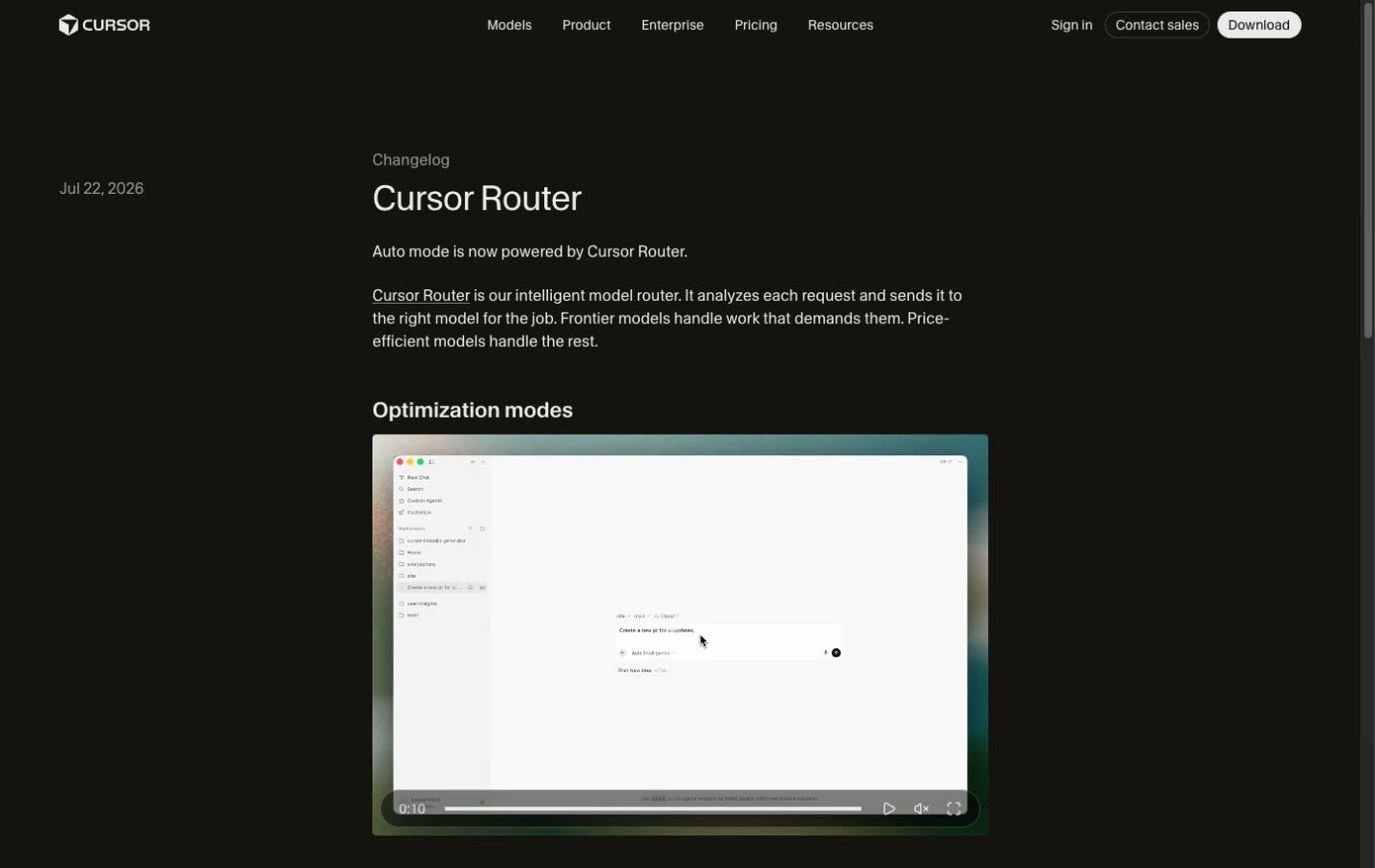
Cursor changed the meaning of Auto on July 22, 2026. It is no longer presented as one reliability-led model-selection setting. Auto is now powered by Cursor Router, which classifies each request and chooses a model under one of three optimization modes: Cost, Balance, or Intelligence.
The model choice is the visible part. The more important change for engineering organizations is that Auto can now carry a team policy: which modes are available, what becomes the default, whether the routed model is visible, and how firmly users are kept on Auto.
The old Auto solved a different problem
Cursor’s earlier documentation described Auto as selecting a premium model for fit and reliability under current demand. It could switch when output quality degraded. An archived official guide made the boundary clearer: Auto did not route by task type.
Router does. Cursor says the new system evaluates each request using signals that include the query, surrounding context, task complexity, and domain. It then routes the request to a model from a changing pool. Users cannot hand-pick the exact model while using Router.
That distinction matters. The old behavior was mainly a reliability decision made behind one label. The new behavior is a request classifier attached to selectable cost-quality policies.
The old logic has not vanished, however. Cursor’s current documentation and staff announcement both describe Cost as the previous Auto routing behavior, now positioned as one mode and sold at bundled, fixed token prices. Balance and Intelligence are newer routing policies, and usage is billed at the selected model’s rate.
Three modes, three operating assumptions
Cursor frames the modes this way:
| Mode | Cursor’s stated objective | Billing behavior |
|---|---|---|
| Cost | Good quality while optimizing token spend | Bundled Auto pricing, independent of the routed model |
| Balance | A daily-driver tradeoff across quality, speed, and cost | Routed model’s rate |
| Intelligence | Frontier quality for harder work | Routed model’s rate |
This is not a stable model picker. The underlying pool can change, and the same mode can route different requests to different models. A team that treats “Balance” as a proxy for one named model will be measuring the wrong object. The operating unit is the policy plus the workload mix.
Cursor’s savings numbers are not independent benchmarks
Cursor says it trained Router on more than 600,000 live requests and ran online A/B tests across millions of requests. It reports that Auto Intelligence reached near-Fable satisfaction at about 60% lower cost, while Auto Balance exceeded Opus 4.8 satisfaction at about 36% lower cost. Cursor also reports roughly 30–50% savings across early-access enterprise accounts that had previously standardized on a single frontier model.
Those are Cursor-reported production and early-access results, not ToolFlock tests. Cursor describes satisfaction and keep rate as outcome signals, but it does not publish the raw workload mix, account-level results, or statistical detail needed to reproduce the comparisons independently. The percentages are useful evidence that Cursor optimized for more than list price. They are not a savings promise for a different repository, task distribution, or review standard.
For an engineering lead, the relevant measurement is therefore local: accepted changes, review burden, regressions, latency, and cost for the same classes of work before and after a routing-policy change. The vendor result is a hypothesis to test, not the conclusion.
The admin controls are not one uniform Teams promise
Cursor’s launch material lists a substantial control surface: enablement by team or group, mode restrictions, a default mode, underlying model allow/block rules, routed-model visibility, and soft or hard Auto enforcement. It also says Router was enabled by default for Teams, while Enterprise administrators had to enable it from the dashboard.
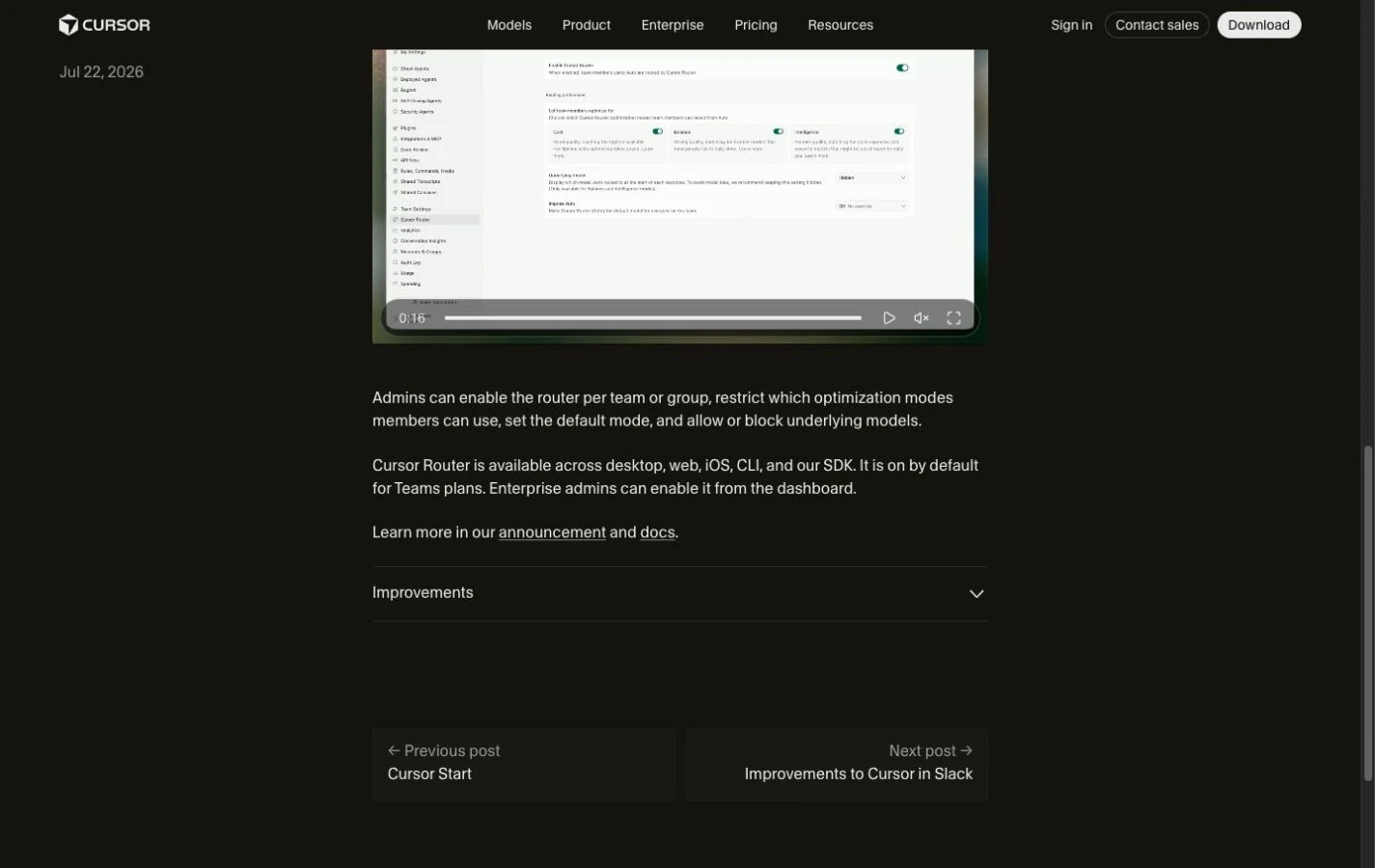
The plan boundary needs more precision than that summary provides. Cursor’s current documentation says Router respects Enterprise Model Access Controls, and a Cursor staff clarification explicitly identifies Model Access Control as an Enterprise feature. That supports a narrow conclusion: allow/block policy for the underlying models is an Enterprise control in the public evidence.
The same public sources do not cleanly assign every mode restriction, visibility setting, default, or soft/hard enforcement option to every Teams and Enterprise tier. The public evidence does not resolve that gap. Treat those individual entitlements as unknown until they are visible in the organization’s dashboard or confirmed in its contract.
The visibility control deserves particular attention. Cursor says the routed model is hidden by default and can be shown. Hiding it may simplify the interface, but it also removes a useful observation when a team is investigating a change in spend or output behavior. If Router is part of an engineering policy, selected-model visibility should be an explicit governance decision, not an unnoticed default.
The safe boundary is policy plus verification
Router can reduce the work of choosing models request by request. It does not remove the need to define what the organization is optimizing for or how exceptions are handled.
Before treating it as a cost or quality control, a team needs to verify six facts in its own environment: which groups have Router enabled, which modes they can select, what becomes the default, whether the routed model is visible, which model restrictions actually apply, and whether enforcement is soft or hard. Billing telemetry then has to be read against the same workload categories and review outcomes—not against Cursor’s aggregate percentages alone.
The July 22 change makes Auto more capable, but also more consequential. It is now a routing policy whose behavior depends on request classification, a mutable model pool, plan-specific controls, and the organization’s own defaults. Teams that verify those boundaries can use Auto deliberately. Teams that do not have simply replaced an invisible model choice with an invisible policy choice.
Discussion
0 replies