

Cursor is often described as an AI code editor, which is accurate in the same way that describing a modern smartphone as a telephone is accurate. The label covers the basic shape while missing the reason people reorganize their work around it.
Autocomplete is part of Cursor. So are chat, code generation, repository search, terminal commands, browser feedback, debugging, planning, and agents that can work beyond a single file. The important part is not any one of those features. It is the loop they form.
A failure appears in a running application. Cursor can read the error, trace it into the repository, change the relevant code, run another check, and leave a diff behind for review. A visual request begins on a product page. The agent can locate the front-end component, follow the request into an API and database layer, then return to a visible result. That continuity is the product’s real center.
It is also where the limits become clearer.
Cursor is fast when the task has evidence: a stack trace, a failed request, a selected interface element, a test, or a precise definition of done. It becomes less dependable when the hardest part is deciding which system should exist in the first place. The agent can move rapidly through a bad plan because a bad plan still gives it a direction.
Three concrete workflows make that distinction much easier to see.
A runtime error is where Cursor starts to feel different
The first case came from a documentation site built with Next.js. A model page failed during rendering and exposed a useful error rather than a vague report: Object.generateStaticParams, followed by a call stack pointing into app/[lang]/docs/models/[id]/page.tsx.
The relevant line attempted to call flatMap on locale data that was not always in the expected array form.
This is ordinary debugging work, but it reveals more about Cursor than a dramatic “build an app” demo. The problem already had four pieces of evidence:
- the failing route;
- the framework-level error;
- an exact file and line;
- the value shape implied by the failed array operation.
Cursor did not need to invent the problem. It needed to connect those signals to the code that produced them.
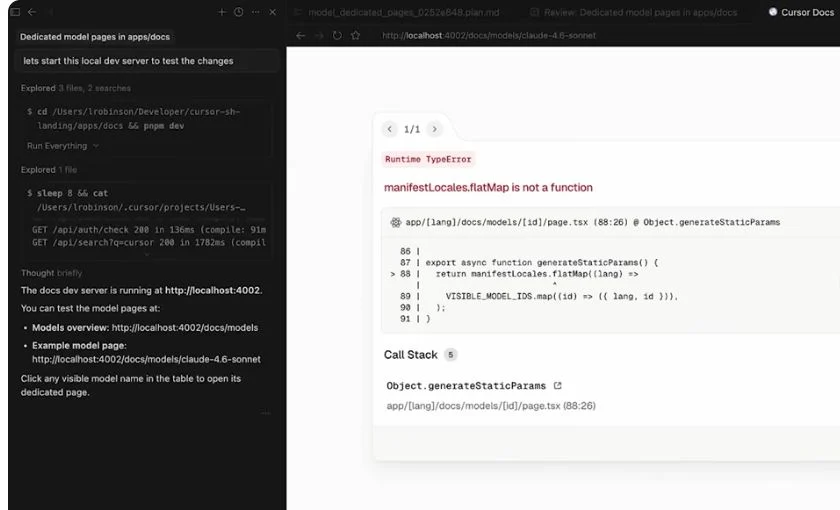
The fix normalized the locale value before the flatMap operation. The page then rendered again.
What felt useful was not the sophistication of the patch. A competent developer could write the same guard quickly. The advantage was the short distance between seeing the broken page and arriving at the exact code path that needed attention.
That distance matters in a real repository. Debugging time is rarely consumed by typing the final two lines. It disappears into reconstructing the failure: finding the correct package, identifying the route, locating the function, understanding the incoming value, and deciding whether the symptom belongs to the caller or the data source.
Cursor compresses that reconstruction when the evidence is already present.
It also creates a more honest review point. The important question is no longer “does this patch remove the error?” It becomes “why was the value allowed to change shape?”
Normalizing the input is a reasonable local repair. It may also conceal an upstream contract problem. If one branch returns an array and another returns an object, converting both at the page boundary prevents the crash without explaining the inconsistency.
This is a recurring Cursor pattern: the agent can be excellent at closing the visible loop while leaving a larger design question open. That is not a failure of the product. It is a reminder that a successful run is evidence of recovery, not proof of architecture.
The strongest input is evidence, not a longer prompt
A second debugging case appeared inside a larger React, FastAPI, SQLAlchemy, and Docker-based commerce project. A product interaction failed. The browser showed a 400 Bad Request, but the revealing detail was that the failing request was the OPTIONS preflight, not the intended POST.
That distinction changes the investigation completely.
If the POST had reached the route, attention would move toward request validation, authentication, or database logic. A failing preflight points earlier in the path: allowed origins, methods, headers, credentials, or middleware order.
Cursor recognized the boundary and moved toward the application’s CORS configuration rather than rewriting the feature that happened to trigger it.
This is the kind of moment that separates repository-aware debugging from generic troubleshooting. “Why is my API returning 400?” can produce a long checklist. “The preflight request fails before the POST is sent” turns the checklist into a narrow path.
The product is most convincing under those conditions. Logs, network behavior, source structure, and the running application all constrain the answer. The agent has less room to improvise and more material to reason from.
The practical lesson is simple: Cursor becomes better when the task is made falsifiable.
“Fix checkout” is weak input. “Clicking Buy Now sends an OPTIONS request that returns 400; the POST never appears” is strong input. “Improve this page” is weak input. A selected component, a screenshot, and three acceptance conditions are strong input.
Prompt length is not the main variable. Evidence density is.
A small heart icon can become a ten-file feature
The same commerce project also showed the other side of agentic speed. A wishlist request began as a visually small change: add a heart action near the existing purchase controls and give users a place to see saved products.
The visible result looked simple. The product page gained a heart control. A wishlist view displayed two saved items, each with Add to Cart and Remove actions. The interface returned a clear confirmation after an item was saved.
Underneath, the task crossed roughly ten files and reached beyond presentation into API and persistence work.
That is exactly the kind of feature where Cursor can feel unusually productive. The request starts in the browser, but the agent can follow it through the component tree, route structure, service layer, data model, and request handling without repeatedly asking for the repository to be re-explained.
The result also demonstrates why “the feature works” is an incomplete conclusion.
| What became visible | What had to exist behind it | What still deserved review |
|---|---|---|
| Heart action beside the buying controls | Event handling, authenticated state, and a wishlist request | Loading, repeated clicks, anonymous users, and button accessibility |
| Wishlist page with saved products | Route, query, response shape, and product rendering | Empty state, stale products, pagination, and ownership checks |
| Add to Cart and Remove actions | Reuse or extension of existing cart and wishlist services | Race conditions, optimistic updates, and error recovery |
| Success confirmation | Mutation result and interface feedback | Whether failure is equally clear and whether the message persists too long |
| Data surviving navigation | Database model and user relationship | Migration safety, uniqueness rules, and deletion behavior |
The table explains Cursor’s appeal better than the finished screen. A small product request often contains a large coordination problem. Cursor can traverse that coordination surface much faster than a disconnected chat assistant.
But speed changes the review burden rather than removing it.
Ten touched files are not automatically excessive for a full-stack feature. They are a signal that the scope should be inspected. Did the agent reuse the existing cart conventions? Did it create a second product serializer? Is wishlist ownership enforced on the server, or merely hidden in the interface? Does removing a product update the UI before the request succeeds? What happens when two rapid saves reach the database?
The generated result makes the happy path easy to see. Experienced supervision is still required to look for the paths the demo does not exercise.
This is also why Cursor can be more valuable to a developer who already understands the system than to someone hoping the system will understand itself. Repository fluency helps the agent move. Domain fluency helps the human notice when it moved too far.
Cursor can recover from a wrong turn—but it takes the wrong turn quickly
The most instructive case was an AI video tool that accepted a video and needed a transcript before generating short-form clips.
The intended architecture was straightforward: obtain an audio rendition, send that audio to the transcription provider, then use the transcript for downstream selection. Instead, the implementation attempted to pass the entire video through a transformed URL.
The failure surfaced at the provider boundary. The transformation URL returned a 302, and the transcription service did not follow that redirect. The request failed before the workflow could continue.
Cursor’s diagnosis was specific:
- the transcription provider received an ImageKit transformation URL;
- that URL responded with a redirect;
- the downstream fetcher did not follow it;
- the worker should fetch the rendition itself, follow redirects, and upload the resulting bytes as multipart data;
- retry and backoff behavior should surround that boundary.
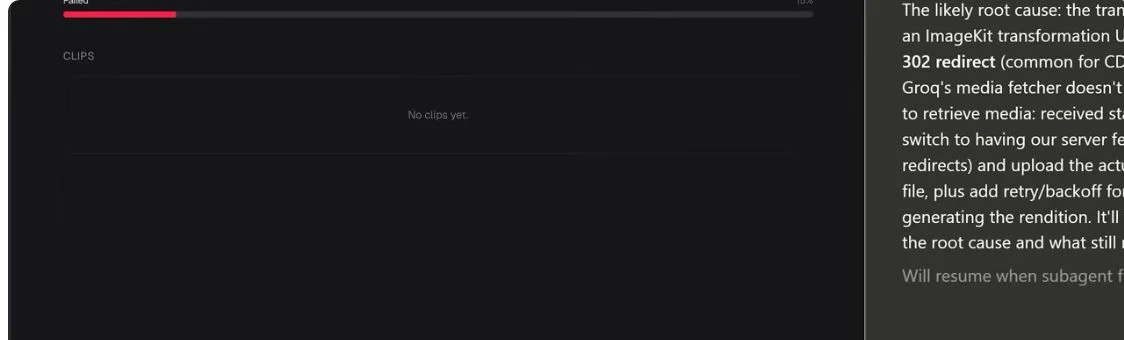
This was a good recovery. It connected an external integration failure to the actual transfer mechanism and proposed a concrete change at the correct boundary.
It was also a preventable failure.
The system already had a product requirement that favored audio extraction. A stronger architectural pass would have established the media path before implementation:
- create or request an audio-only rendition;
- wait until the asset is available;
- retrieve the bytes through a server-controlled request;
- send a supported media payload to transcription;
- retain identifiers and status so the job can resume safely.
Instead, the agent advanced with a convenient assumption and discovered the mistake through runtime failure.
That says something important about Cursor’s core capability. Planning, rules, repository context, and an agent interface improve continuity. They do not guarantee that the selected plan is good.
Once a direction is accepted, Cursor is optimized to make progress. That is usually an advantage. In ambiguous systems work, it can become acceleration in the wrong direction.
The correct response is not to write an enormous prompt. It is to place review gates before expensive decisions: data ownership, trust boundaries, third-party contracts, irreversible migrations, and background-job architecture.
Cursor is best allowed to run when the next result can be checked cheaply. It should be slowed down when a clean implementation could still encode the wrong system.
What the three cases reveal
The examples cover different surfaces, but the pattern is consistent.
| Task | Where Cursor was strongest | Where judgment remained essential |
|---|---|---|
Next.js route failed in generateStaticParams | Connected a visible stack trace to a narrow source-level repair | Deciding whether normalization fixed the cause or only the symptom |
Commerce request failed at OPTIONS | Used network evidence to identify CORS rather than application logic | Confirming the security and deployment implications of the configuration |
| Wishlist crossed UI, API, and storage | Carried one user outcome through a large repository without losing context | Reviewing blast radius, authorization, state transitions, and edge cases |
| Video transcription followed the wrong media path | Diagnosed the redirect boundary and proposed a recoverable transfer flow | Choosing the correct architecture before implementation began |
This is Cursor’s actual kernel: not omniscient coding, but rapid closure of evidence-bearing loops.
The phrase “evidence-bearing” matters. When the agent can see what failed and where, it often behaves like an unusually fast pair programmer with strong repository recall. When the requirement is mainly conceptual, it behaves more like a very capable implementer waiting for someone else to own the design.
The interface encourages progress more than restraint
Cursor’s working environment makes agent activity easy to follow. Plans, changed files, terminal output, browser state, checkpoints, and follow-up prompts can remain close to one another. That continuity reduces context switching, but it also creates a polished sense of momentum.
A completed task list feels authoritative. A tidy diff feels safe. A page that renders feels finished.
Those signals should be read as navigation aids, not quality guarantees.
The most productive operating style is deliberately uneven:
- let the agent move quickly through discovery, file tracing, repetitive edits, and reproducible corrections;
- pause at data models, external contracts, access control, migrations, and broad refactors;
- require visible evidence for the result;
- read the diff according to risk, not according to how confidently it was summarized;
- keep changes small enough that rollback remains credible.
That balance captures the speed without outsourcing responsibility.
Where Cursor earns its place
Cursor is easiest to justify when a task has several of these properties:
- the answer depends on an existing repository rather than an isolated snippet;
- more than one layer or file is likely to change;
- the failure can be reproduced;
- the result can be inspected in a browser, terminal, test, or diff;
- the developer already knows which tradeoffs require intervention;
- repeatedly rebuilding context would cost more than supervising the agent.
It is less compelling for a one-line question, a disposable script, or work whose main difficulty is still product discovery. A lighter assistant may answer faster. A whiteboard may be more useful. In some cases, writing no code is still the best result.
The dividing line is not whether Cursor can complete the task. It is whether its continuous loop saves more attention than the generated changes consume.
Verdict
Cursor’s best feature is not autocomplete, Agent mode, or access to a particular model. It is the way repository context, execution, runtime evidence, and review can stay connected while a task changes shape.
The Next.js failure showed the loop at its cleanest: concrete error, exact code path, small repair, visible recovery. The CORS failure showed how network evidence can prevent wasted work in the wrong layer. The wishlist feature showed how much coordination can hide behind a minor interface request. The transcription failure exposed the limit: Cursor can repair a bad assumption quickly, but that is not the same as choosing the right assumption.
That combination makes the product powerful and slightly dangerous in the same way.
Cursor rewards developers who can define evidence, review boundaries, and recognize architectural risk. It is less suitable as a substitute for those skills. The agent makes implementation cheaper; it can also make a weak decision look complete sooner.
Used with deliberate checkpoints, Cursor can remove a remarkable amount of friction from real repository work. Used as an autonomous answer machine, it simply reaches the next unanswered engineering question faster.

Discussion
0 replies