
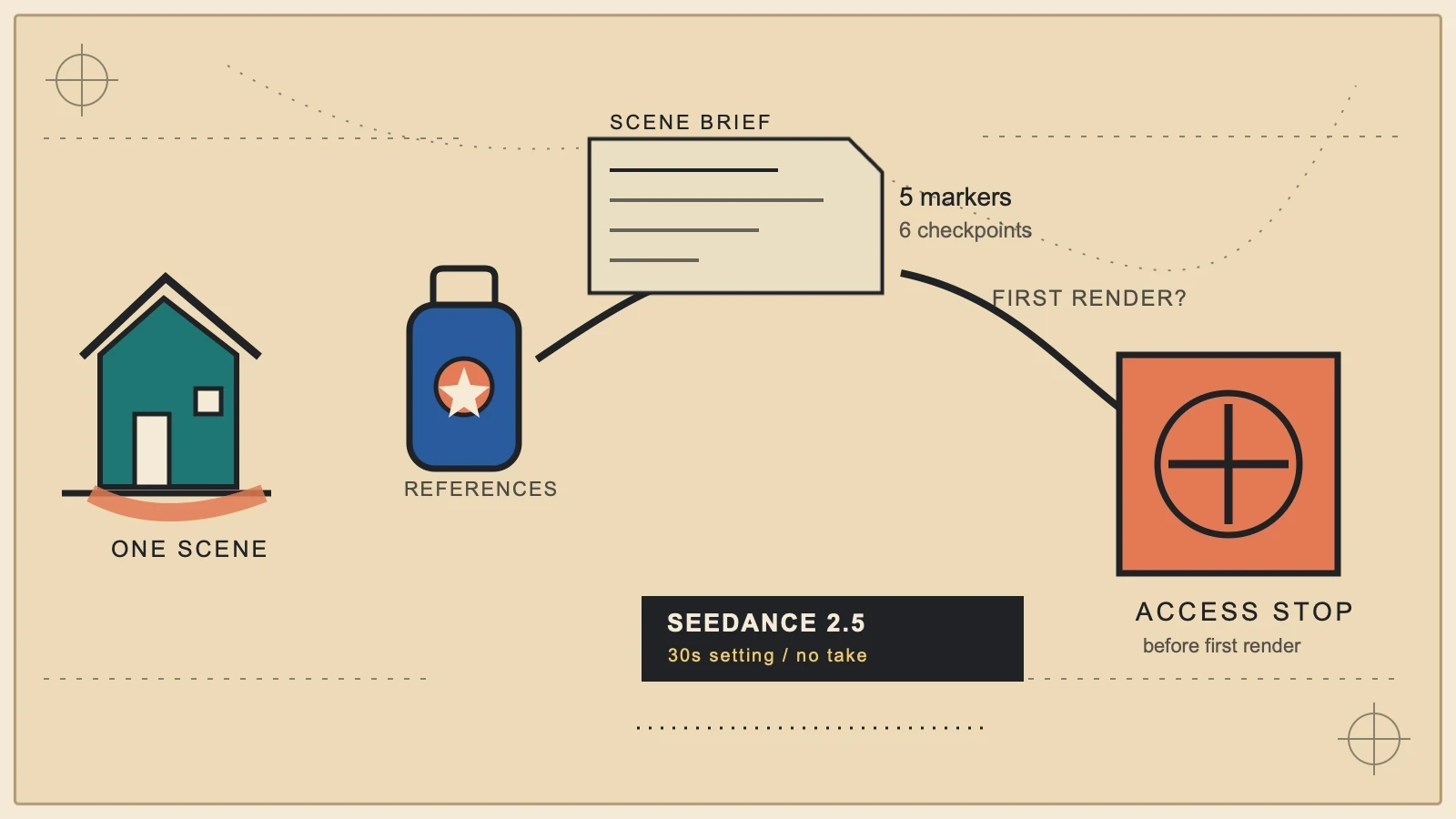
Keeping the same person, storefront, and product label visible across a 30-second video sounds like a small production job until the clip is meant for a client. The practical choice is whether to try Seedance 2.5 now or wait for proof that its reference path can produce a usable take. The current Higgsfield creator route answers only the first part: it exposes Seedance 2.5, a References mode, and a 30s setting, then stops at Login and Sign up. This review follows a self-authored Northstar Refill scene through that path and records the missing step. It does not claim a generated result, 50 accepted references, or continuity success.
The job was clear before the render
The scene was designed around a familiar handoff: a small refill shop needs a short clip that keeps one shopkeeper, one kiosk, one bottle label, the rainy light, and the handoff action recognizable from opening to final wide shot. That is a more useful test than asking whether a model is "consistent" in the abstract. A continuity marker is simply a detail checked again at several moments in the same scene.
The fictional Northstar Refill kiosk has a green awning beside a rainy crosswalk. A shopkeeper in a coral work jacket carries a teal canvas tote. A cobalt refill bottle with an orange compass label crosses the counter. The planned sequence moves through six five-second windows: open the kiosk, hand over the bottle, move toward the shelf, return through the rain, inspect the label, and finish on a wide view.
The intended input condition was a 50-item reference pack split across the subject, location, bottle and label, lighting and style, motion, and storyboard. None of it was uploaded. The scene is a test brief and decision rubric, not a Seedance output.
The public setup reaches 30 seconds, then stops
The visible path is straightforward: choose Seedance 2.5, choose References, add an image, video, or audio reference, write a prompt, and set the duration. The control reported a 4–30 second range and displayed 30s at its end state on the current creator route.
That is useful preparation. It shows where a continuity-heavy job would begin and makes the target duration concrete. It does not show that media was accepted, a prompt was submitted, or a clip was made.
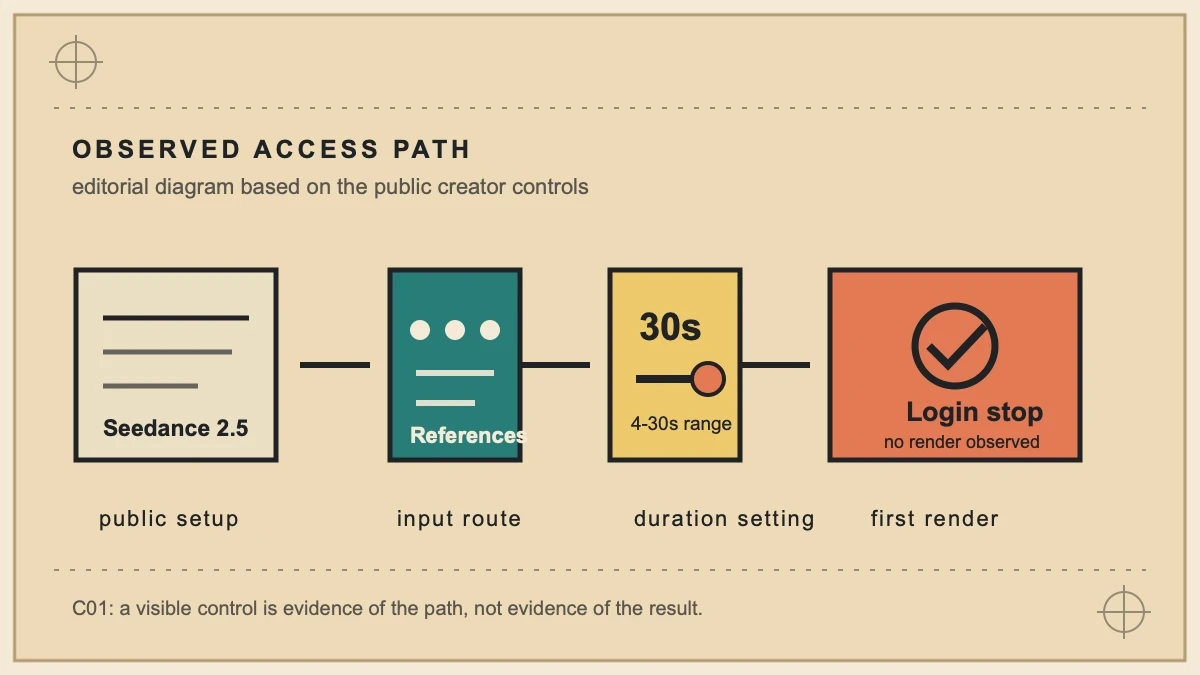
The next visible step remained Login or Sign up. There was no result, history, or generation receipt to inspect. For a creator with a deadline, that changes the task from delivery planning to access checking: the scene and settings can be lined up, but there is no visible take to review, edit, export, or hand to a client. The visible 30s value is a setting, not evidence of a 30-second clip.
Official numbers do not close the missing step
The official pages explain why this test is worth running. Dreamina's Seedance 2.5 product page describes up to 30 seconds and up to 50 multimodal references. Its access guide says availability can vary by account and region. Higgsfield's Seedance 2.5 page repeats the broad 30-second and 50-input claims.
Those are official capability claims, not observations from the Northstar scene. Dreamina's creator route opened a sign-in gate in this environment, while Higgsfield exposed the public controls without returning an authenticated result. The pages define what a future run should check; they do not establish that an account can accept this exact pack or carry its details through six checkpoints.
The official Higgsfield showcase answers a different question. The vendor-hosted file is 30.041667 seconds long and moves from a cyclist in an alley to an interior close-up and then a crowded market corridor at the retained 00:00, 00:15, and 00:29 points. It is a curated sequence chosen for public demonstration, not the Northstar scene under the same inputs. Its input pack, edit history, retries, and selection criteria are unknown. A polished long clip can show what the vendor wants viewers to imagine; it cannot establish how a specified scene behaves in a reproducible user workflow. The showcase remains private in this run and is not used as a body visual.
Kompozy's independent review, published on June 24, separates model capability claims from access maturity and notes that no independent benchmark was available at announcement. An independent benchmark is simply a repeatable outside test. That distinction sharpens the reader's decision without answering it: a capability can be advertised, access can vary, and a dependable client workflow still needs a visible clip from the locked scene.
The missing run has a fair recovery path
The next test does not need a grand benchmark. It needs the same scene, the same input condition, and a visible record of what happened. An authorized run should:
- Use an authenticated route without changing the Northstar Refill brief.
- Prepare the planned 50-item pack and record any file-type, count, size, or account limit before submission.
- Keep the visible upload or acceptance state, the generation receipt, and any credit or usage information.
- Capture the sequence at 0, 5, 10, 15, 20, 25, and 30 seconds.
- Check the five markers at every boundary: shopkeeper and jacket, kiosk and awning, bottle and label, rainy lighting, and handoff action.
- Record retries, export, and the final handoff state, including any point at which the scene becomes unusable.
The important result is not a single attractive frame. It is whether the details that matter to the handoff remain checkable as the scene changes. If the route is unavailable, the reference receipt is missing, a checkpoint cannot be captured, or export and handoff evidence are incomplete, the test should stop before making a continuity or production judgment.
Who should inspect the path now, and who should wait
The current path is useful for a creator who wants to inspect access, prepare a scene brief, and define a fair test before spending project time. It is also enough to show that a 30-second target and a References workflow are visible on the public Higgsfield surface.
It is not enough for a client-facing promise about continuity, a measured production score, or the usefulness of 50 references. No marker has a recorded pass or drift state because no marker reached a generated frame. The official number and showcase can motivate the next test, but neither replaces it.
For a producer with a delivery date, the missing first render is the decisive craft issue. There is no take to cut, inspect, export, or hand off. Seedance 2.5 may still be worth trying when an authorized route is available, but the responsible decision from this run is to prepare the test and wait for the evidence that crosses the access stop.
Discussion
0 replies