
Recraft is an image-generation workspace for people who expect to keep designing after the prompt. It can produce raster images and vectors, arrange them on a shared canvas, and expose generated vector elements as shapes that can still be selected, recolored, and exported.
That last part is the reason to pay attention.
Plenty of image generators can make an attractive first pass. The harder question is what happens when the result is close but not finished. If one color is wrong, does the whole image have to be generated again? If a character must appear across several assets, does it still look like the same character? If a reference edit succeeds, which model actually performed it?
To make those questions visible, we used one deliberately simple brief throughout. It asked for a friendly red sheep carrying a small black toolbox, drawn as a flat editorial vector illustration on a cream background. The palette was limited to red, black, cream, and pale blue. The sheep then had to survive three kinds of work: generation, a local vector correction, and a controlled reference edit.
The exercise did not produce a simple verdict. Recraft was much better at preserving an editable object than it was at reproducing a stable character.
The image that was almost right
The most revealing result was not the prettiest one. It was a red sheep with a pale-blue muzzle.
The composition worked. The toolbox was readable. The character had enough personality to keep. Only the muzzle color felt wrong.
In a prompt-only workflow, that small error would usually trigger another generation. The correction might fix the muzzle while changing the face, body, pose, or composition. Recraft offered a less dramatic option: the muzzle existed as an individual vector shape. Selecting it exposed the fill, and replacing the color changed that part without rebuilding the scene.
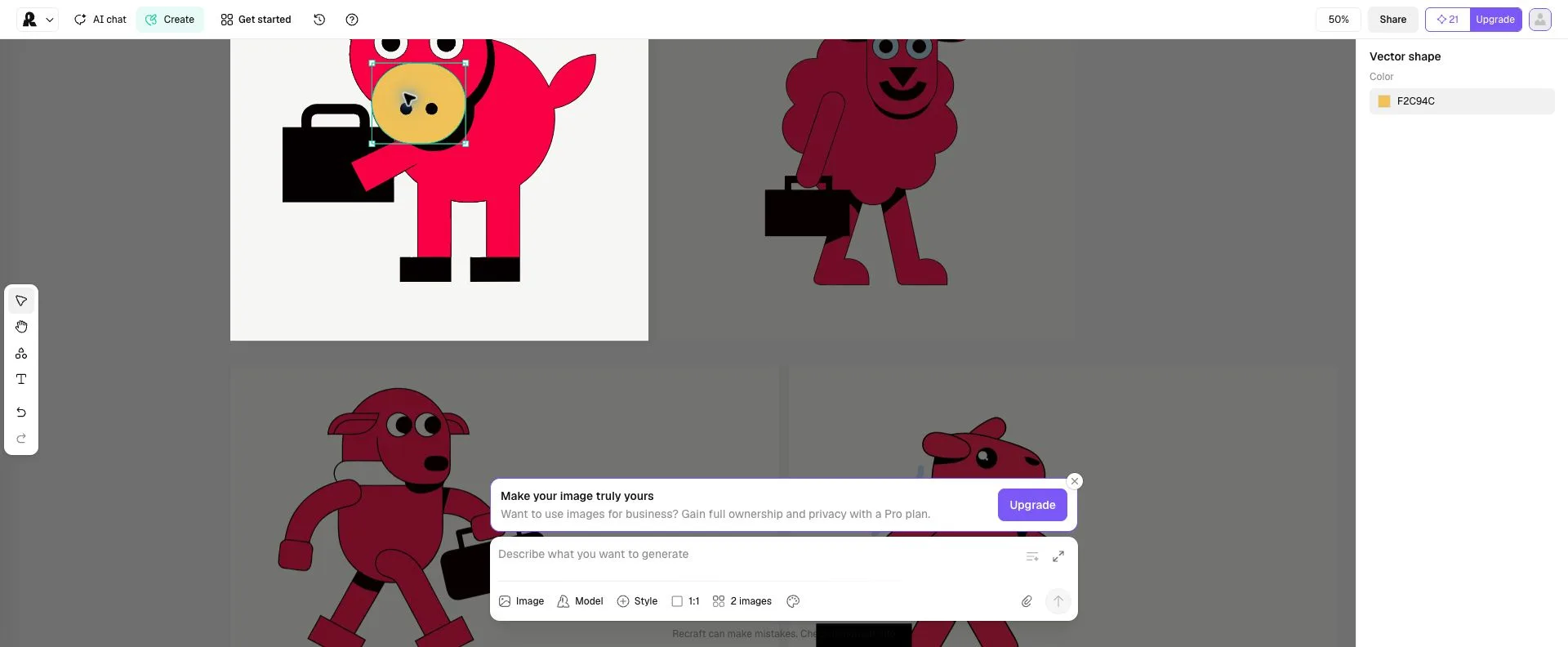
The face, body, toolbox, and background stayed where they were.
That modest edit explains Recraft better than a gallery of polished outputs could. The value of the image changed because the unit of judgment changed. We no longer had to accept or reject the entire generation. We could keep the composition, keep the character, reject one fill, and continue.
For an icon, badge, spot illustration, or simple brand asset, this is practical control. An almost-right result can move forward without reopening the whole prompt.
It does not mean every SVG will arrive ready for a production system. We confirmed that generated vector elements could be selected and recolored. An SVG export path was also present. We did not audit the exported path structure, layer naming, or markup. A team with strict handoff requirements should still open the file in its destination editor before approving it.
The important distinction is narrower: Recraft can turn some generated images into working files rather than disposable samples.
The palette survived. The character did not.
The same brief that revealed Recraft’s editing strength also exposed its clearest weakness.
Across repeated outputs, the requested color direction remained recognizable. Red, black, cream, and pale blue continued to organize the images. The toolbox usually survived as a motif.
The sheep wandered.
One version was compact and animal-like. Another stood upright on long, human-shaped legs. Faces changed. Body proportions changed. The toolbox moved from beside the character to in front of it or into its hand.
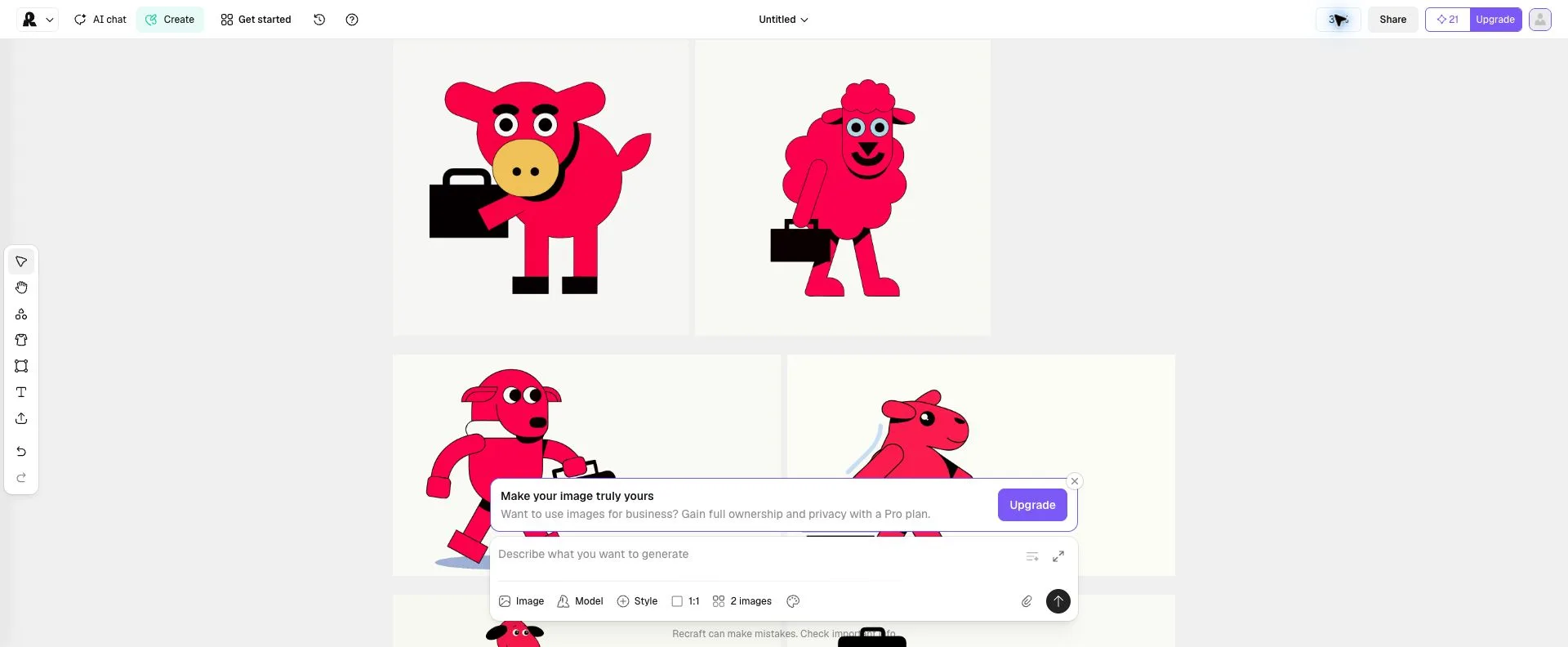
The outputs belonged to the same visual neighborhood, but they did not reliably depict the same individual.
| What remained recognizable | What changed | Where the result still fits |
|---|---|---|
| The four-color direction | The amount and placement of each color | A loose family of campaign illustrations |
| The idea of a red sheep | Body type, face, and proportions | Exploration rather than an approved mascot system |
| The black toolbox motif | Its size and relationship to the character | A recurring prop that still needs art direction |
This is the difference between an illustration family and a character system.
Related colors can make separate images feel connected. They cannot make a changed face and body read as the same mascot. For a campaign that welcomes variation, the drift may be useful. For a character that must cross a homepage, email sequence, onboarding screen, and sales deck, it creates a new review burden.
The practical response is not simply to write a longer prompt. A recurring-character workflow needs rejection criteria before generation begins. Which facial features cannot change? Must the character stay upright? Can the toolbox move? How much variation can the body tolerate before it stops reading as the same identity?
Without those rules, a stable palette can make a drifting character look more controlled than it is.
This finding comes from one controlled mascot brief. It should not be treated as proof that every subject or style will behave the same way. It is a reason to test the exact recurring character you intend to ship before building a production workflow around prompt-only consistency.
Recraft Studio hides an important model boundary
The reference-edit instruction was intentionally unambitious: turn the black toolbox bright yellow while leaving the sheep, pose, proportions, background, composition, and every other color alone.
The edit worked. The toolbox changed, while the broader image remained visually close to the source.
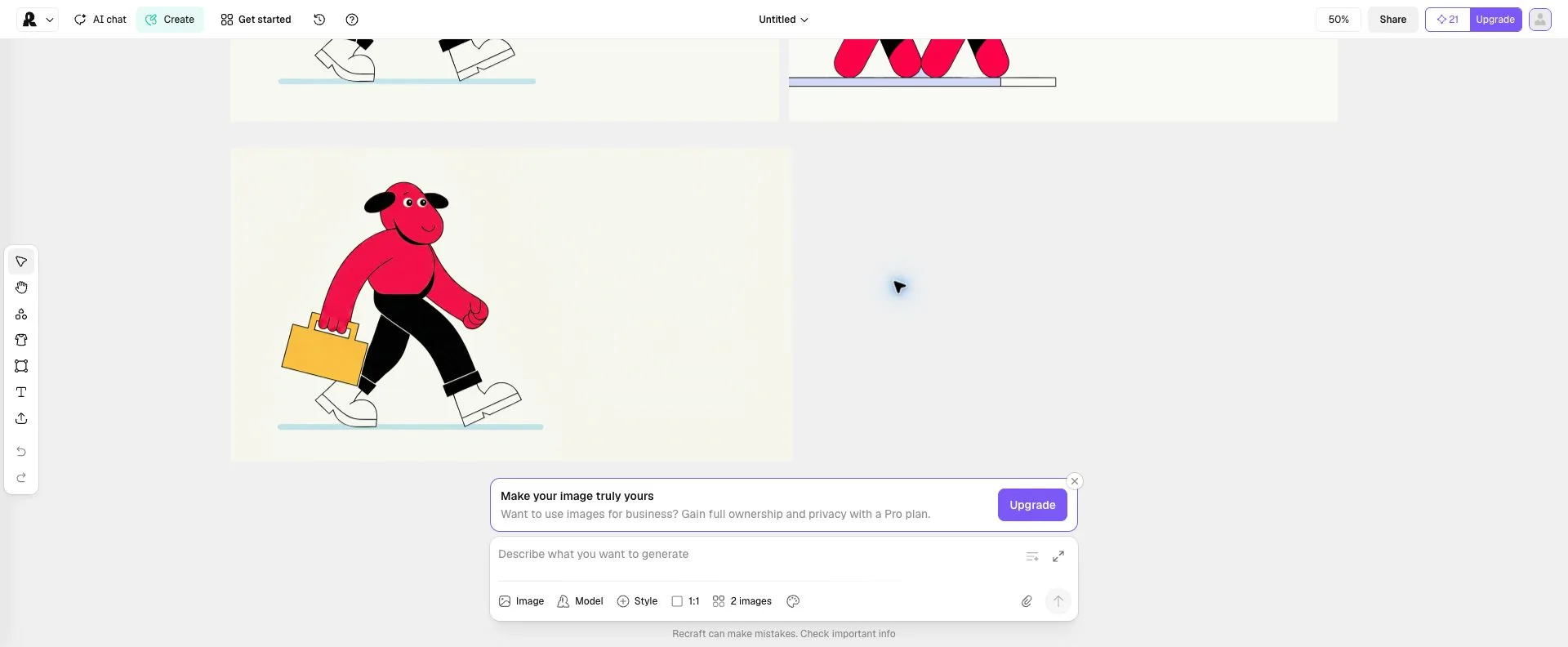
But the route mattered. Recraft’s native generation model did not accept the attached image for this task. Studio offered an integrated model instead.
From a designer’s seat, the job still happened inside Recraft. The same canvas received the reference, instruction, and result. From a production or policy perspective, however, the asset crossed into another model workflow.
That difference can matter when a team needs to know which provider handled a client image, which usage terms apply, or whether the active plan provides the privacy required for confidential work.
This is not a reason to dismiss the successful edit. It is a reason to describe it accurately: Recraft Studio completed the task, but the native Recraft generation route did not. A platform can be valuable because it gathers several routes in one workspace. Convenience should not erase which route produced the output.
What we would trust Recraft with
Recraft earns trust through editable structure, not perfect repeatability.
| Task | Editorial call | Why | Guardrail |
|---|---|---|---|
| Icons and simple vector assets | Use it | Small color corrections can remain local and the artwork can stay editable | Inspect the exported SVG before shipping |
| Editorial or campaign illustrations | Use with review | A shared palette can connect a family of images even when compositions vary | Decide how much character variation the campaign can tolerate |
| Recurring mascot systems | Not prompt-only | Prompt-only outputs changed features that defined the character | Use approved references and explicit rejection criteria |
| Confidential client work | Verify first | The active plan and model route determine privacy and usage boundaries | Recheck current terms before uploading sensitive material |
Recraft is not a replacement for Illustrator, Figma, or a dedicated vector editor. It moves the handoff. Some first corrections can happen before generated artwork leaves the canvas, which makes the distance between “interesting output” and “usable asset” shorter.
That advantage is strongest when the composition is already worth keeping. If the fundamental subject is wrong, shape-level editing will not rescue it. If the same character must return unchanged, a consistent palette will not be enough.
The case for keeping it in the workflow
Recraft did not make the red sheep perfectly repeatable. It made one imperfect sheep easier to keep.
That is a meaningful product advantage. A selected shape can be corrected. A promising composition does not have to be thrown away because one fill is wrong. Vector output can remain part of a design process instead of becoming a flattened endpoint.
The trade-off is equally clear. Recraft held the art direction better than it held the identity of the character, and its successful reference edit crossed into an integrated model.
Use it when editable structure is the scarce thing. Add references, rules, and human review when the same face and body must return again and again.

Discussion
0 replies