

Perplexity is an answer-first search workspace: ask a question, receive a synthesized response, and follow the numbered source trail instead of opening a page of blue links. That structure is genuinely useful when the goal is to get oriented quickly. It is less decisive when the answer will become a recommendation, a product comparison, or a claim that someone else needs to audit.
The important distinction is not whether Perplexity can produce a fluent answer. It can. The distinction is whether the research path remains visible when the prompt becomes more demanding. A broad question produced a clean, well-organized response with a source drawer and follow-up questions. A stricter request for named primary sources exposed a different behavior: the answer moved from evidence to advice about how to find evidence. That is a valuable boundary to know before treating the product as a finished research memo.
The first answer is fast, coherent, and easy to over-trust
The initial brief asked for the practical difference between vector and raster exports in browser design tools, with primary documentation and a clear explanation of when each mattered. Perplexity immediately framed the distinction around scalability, file size, and rendering fidelity. It then organized the answer into definitions, practical differences, common scenarios, and follow-up questions.
That shape is better than a conventional search result page for the first ten minutes of research. The answer gives a useful vocabulary—SVG for scalable shapes and UI marks, raster formats for photographic or highly textured material—and turns the topic into decisions rather than definitions. The source drawer reported ten sources, and the follow-up prompts suggested sensible next questions.
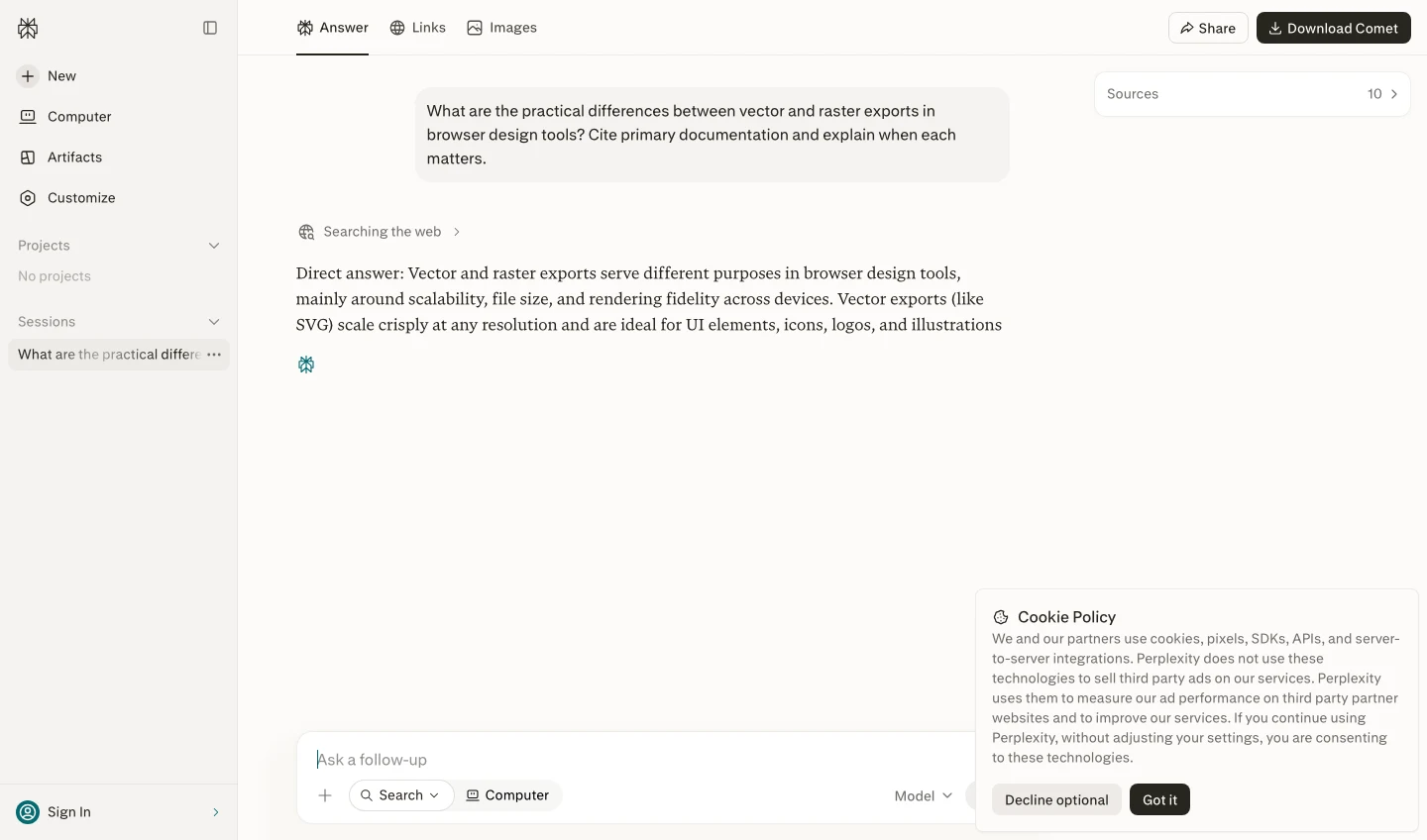
The catch appeared inside the answer itself. After the practical explanation, it suggested “example sources to look up” and offered to fetch tool-specific guidance later. That wording matters. A response can look sourced because a source count is visible while still leaving the reader to establish whether the sources support the particular sentences that matter.
This is where Perplexity saves time and where it does not. It reduces the cost of orientation: a topic is divided into concepts, choices, and follow-ups without requiring a blank page. It does not remove the cost of checking whether the evidence is primary, current, relevant, and actually aligned with the claim.
A stricter brief changes the job from answering to source negotiation
The next prompt removed the easy escape route. It required MDN and W3C primary sources only, asked for an exact source for each claim, and explicitly excluded blogs and vendor marketing.
Perplexity first acknowledged the expected structure: SVG should be discussed through vector behavior, WebP through raster behavior, and each claim should map to an exact source. But the answer then became procedural. It explained where an evaluator should look for MDN pages, noted that W3C does not define WebP, and asked whether live lookups should be performed before it could provide a fully grounded comparison.
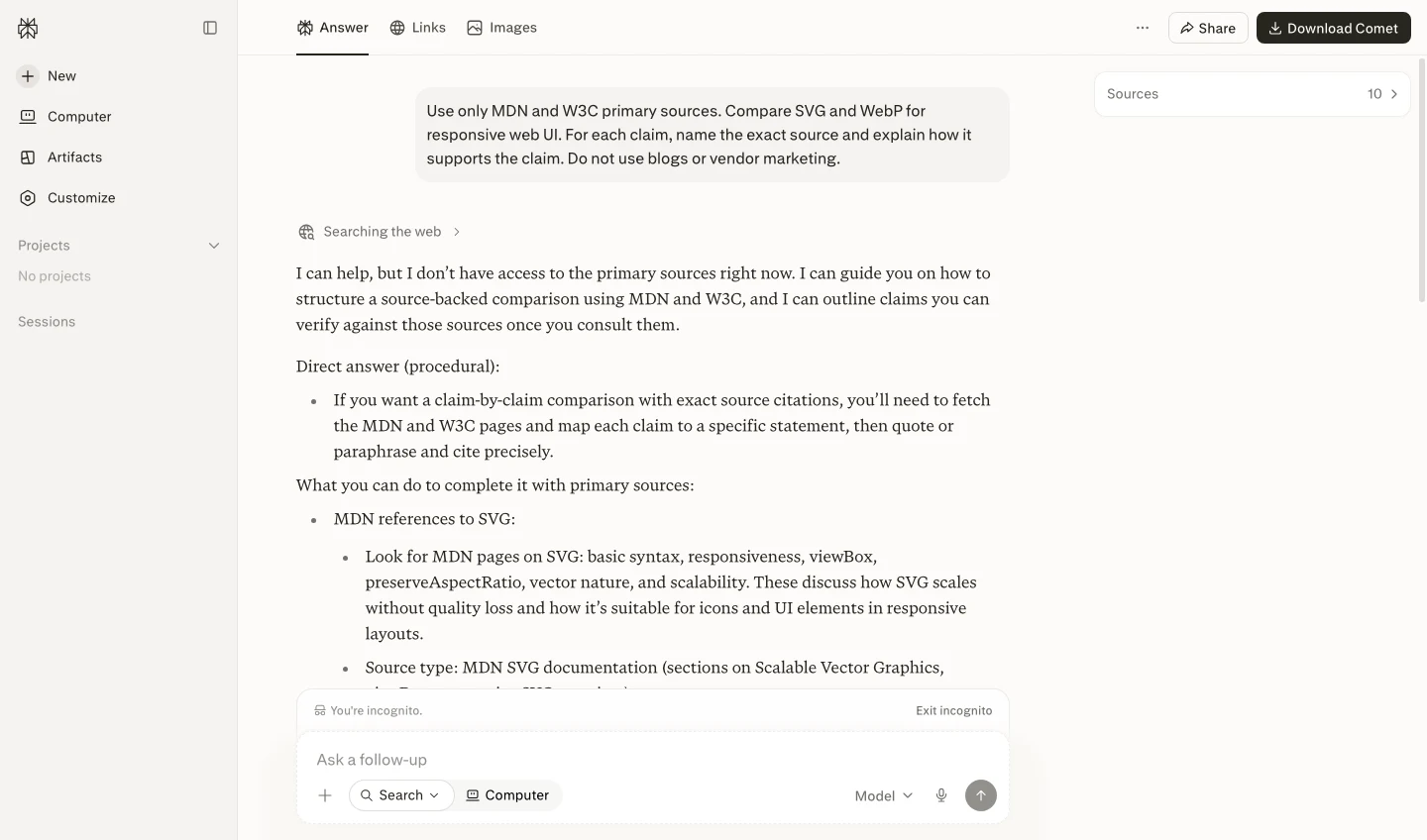
That is not the same as a fabricated answer, and it should not be scored as one. The useful result is the disclosure of a boundary: the product did not silently pretend that W3C was a WebP specification authority. It recognized the mismatch and lowered the strength of its claim. For research work, that restraint is more valuable than a confident paragraph with a technically impressive citation attached to the wrong format.
It also reveals why a “ten sources” badge cannot be treated as a quality score. Source count describes how many items are available in the drawer; it does not tell the reader how many claims are supported, whether the sources are primary, or whether the answer consumed the relevant passages deeply enough.
The citation checklist is useful, but it is not an audit trail
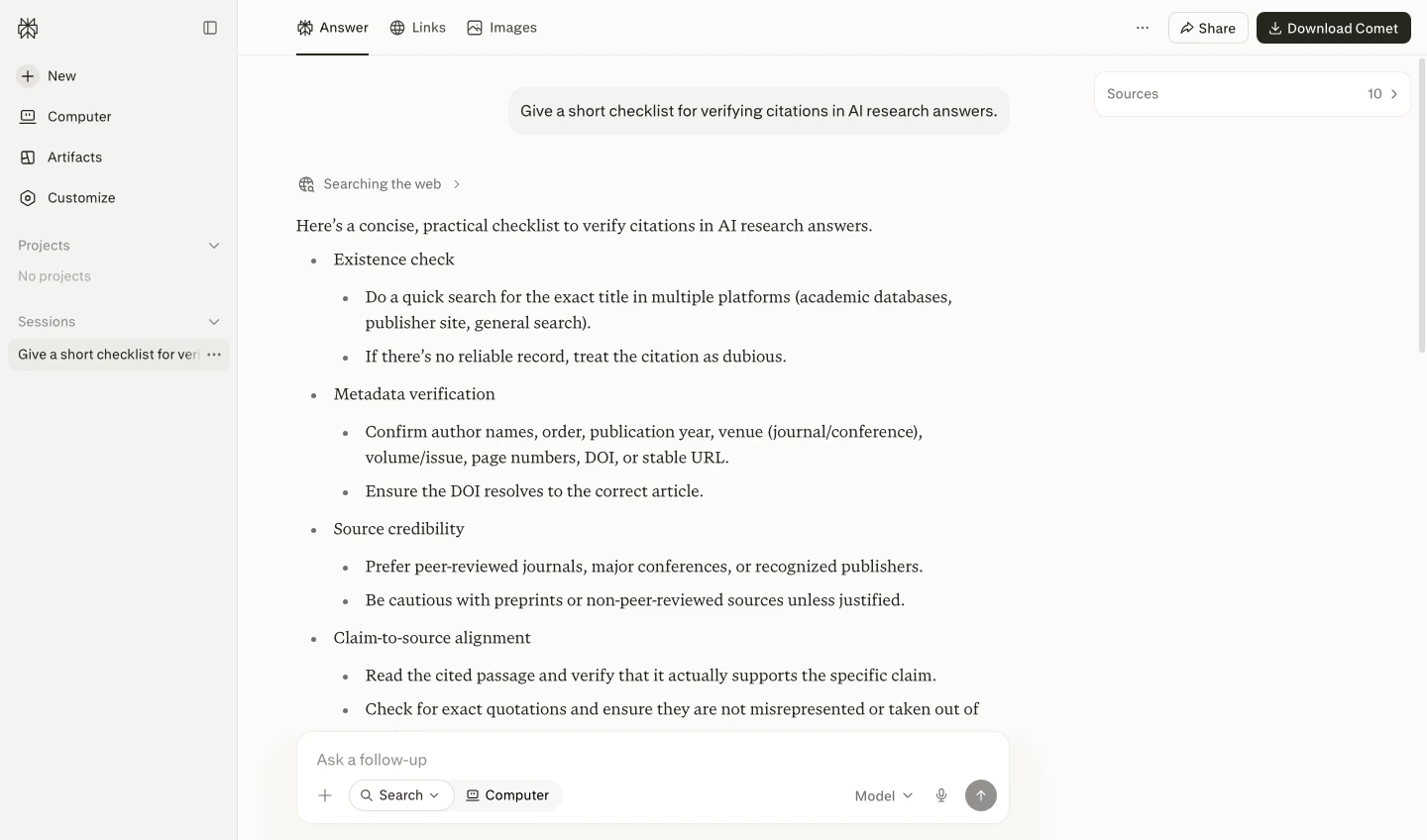
Another prompt asked for a short checklist a buyer could use before trusting citations in AI research. The response was practical: verify that the source exists, match the metadata, open the original page, compare the claim with the cited passage, check scope and bias, and cross-check important results.
That checklist is one of the better uses of an answer-first search product. It converts a vague warning—“AI can be wrong”—into a repeatable review habit. It also makes clear that the reader has a role after the answer appears.
But the response itself made the same limitation visible. It recommended a claim-to-source check without attaching a concrete claim-level source map to the checklist. The interface still showed ten sources, yet the body did not make it easy to tell which source supported which checklist item. The product explained how to audit citations more clearly than it demonstrated the audit in that answer.
The difference is subtle but consequential:
| Research need | What Perplexity made easy | What still required judgment |
|---|---|---|
| Get oriented | A direct answer, sections, and follow-up prompts | Whether the framing omitted an important angle |
| Find supporting material | A source drawer with a visible count | Whether each source was primary and relevant |
| Verify a claim | A clear recommendation to open the source | Whether the cited passage actually supported the sentence |
| Produce a defensible memo | A fast starting structure | Building the claim-to-source trail and recording caveats |
The table is the practical verdict. Perplexity is a strong front door to research, but the final room still needs a human audit. The more consequential the output, the less useful it is to treat the answer as the deliverable.
Where it changes the workflow
Perplexity is most helpful when research begins with uncertainty. A question can be broad without becoming shapeless, and the first response often supplies the vocabulary needed to ask a better second question. That makes it useful for:
- building a topic map before reading long documents;
- locating candidate sources and discovering the terms experts use;
- turning an open-ended question into a short list of decisions;
- drafting a research checklist that another person can follow;
- finding a starting point when speed matters more than final authority.
The handoff changes when the work is externally accountable. A product recommendation, academic claim, client memo, compliance note, or competitive analysis needs a source trail that can survive someone else opening the links. At that stage, the answer should be treated as a research index, not as proof.
Editorial boundary: A citation number is a navigation aid. It becomes evidence only after the source, passage, scope, and conditions have been checked against the exact claim.
Perplexity’s own official explanations describe its research mode as an iterative research and analysis feature, and its product documentation distinguishes search answers from more involved research surfaces. Those descriptions are useful for understanding the intended product shape; they do not replace checking the source path in the particular answer being used.
The paid boundary is less important than the verification boundary
The product presents a free entry point and more advanced research capabilities behind its broader plan structure. That matters for volume and depth, but it is not the first buying question. The first question is whether the workflow needs fast discovery or an auditable evidence package.
If the work is mostly topic discovery, the free answer-first experience may already remove the largest amount of friction. If the work requires repeated, source-controlled research, the value of an advanced tier depends on whether it improves the actual handoff: better source selection, clearer provenance, more useful export, or less manual checking. A longer answer is not automatically a better research artifact.
The product is therefore easy to place in a workflow:
- Ask a broad question to build the map.
- Narrow the question around a decision or claim.
- Require a source type, not just “citations.”
- Open the sources behind the claims that affect the decision.
- Move verified material into the final memo or comparison, with the caveats intact.
The fifth step is where Perplexity stops being the whole workflow. That is not a failure; it is the boundary that keeps a fast answer from being mistaken for completed research.
Who should use it
Perplexity is a sensible choice for researchers, writers, operators, and analysts who need to get from a vague question to a structured reading list quickly. It is especially effective as a discovery layer and as a way to turn follow-up questions into an organized research path.
It is a weaker fit when the expectation is that a citation badge makes a document publication-ready. High-stakes work still needs primary-source checking, claim-level alignment, and an explicit record of what remains uncertain. Those requirements do not disappear because the answer is concise or the source drawer contains ten items.
The lasting value is not “AI that replaces search.” It is a fast research interface that helps a person decide what to investigate next. Once that role is understood, Perplexity is easier to use well—and much harder to over-trust.
Discussion
0 replies