

Meta's beta is aimed at work that spans a repository
A team with a large codebase rarely has a one-file problem: a change can require planning, edits across several files, and checks that continue after the first answer. On August 5, 2026, Meta announced Muse Code beta, a terminal coding agent powered by Muse Spark 1.2. A terminal coding agent is a command-line program that takes a software task and works through files and tools; a beta is an early version released while access and behavior may still change. This story does not verify a completed installation or repository task. Meta's announcement and current developer page establish the launch and the announced product boundary, not successful use.
Meta says Muse Code is built around persistent sub-agents: background helpers that remain active through a session rather than being created for only one short step. Meta's official pages also describe parallel workers and reviewers, plus a local event log for model calls, tool runs, approvals, and edits. For a team working across a large multi-file project, that matters because planning, changing, and validating code can stretch beyond a single chat turn. The relevant question is a long-running repository workflow, not simply whether a tool can suggest the next line. Meta's announcement and developer page document those behaviors.
The practical line is narrow: the beta is announced and its operating model is described; access, installation, and a completed repository task remain unverified here. The launch gives a large-project team a reason to inspect the option, not evidence that it can yet be used for that team's codebase.

The helpers are meant to stay with the session
The word “persistent” carries most of the product's operating claim. Meta says a sub-agent is not a one-off helper created for a single prompt: it is a specialized background helper that remains active throughout the session. Meta says these helpers can carry out next steps and choose when to report back to the main agent, a design intended to reduce repeated information gathering and the amount of steering needed for multi-step work. Meta's announcement
Meta's developer description adds a parallel layer. It presents Muse Code as coordinating workers that can operate at the same time, alongside background reviewers. In plain terms, the announced division of labor is for workers to move separate parts of a task forward while reviewers check the resulting work. That is a description of the intended workflow, not evidence that a particular repository was changed successfully. Muse Code on Meta's developer site
The local event log is the record meant to tie those actions together. Meta says every model call, tool run, approval, and edit is appended to the log. For a reader, that is a local timeline of what the session requested, which tools it ran, which actions received approval, and which edits were made. Meta says the record is intended to make the runtime replay-exact and restart-safe, so a crash can resume from the recorded point. Meta's announcement
The bundled skills are explicit control points for that workflow. Meta says /plan turns a task into an approval-gated plan, /grill stress-tests that plan until it holds up, and /goal works toward successful completion of the specified objective. They are meant to structure planning, challenge the plan, and keep execution tied to the requested goal, not to serve as proof that the goal has been reached. Meta's announcement
The announcement does not prove that persistence works across machines, that workers share credentials, where repository data moves, or that arbitrary large repositories will be completed. It also does not provide a runtime result for the beta. The workers, reviewers, event log, and skills remain Meta's stated operating model until a repeatable task can be run and its result inspected. Meta's announcement; Muse Code on Meta's developer site
The install command is the first practical question
Before asking whether Muse Code works on a large repository, ask what its one-line installer is set up to change locally. Meta's current Muse Code page presents the command for macOS and Linux; the linked public installer is a shell script with a local footprint.
A static snapshot captured on August 8, 2026 (SHA-256 5196d820127a241211c96cf38f0b2e30cff8506a82e9da9508cd5f826632a0ca) passed bash -n. That checks shell syntax only. The script was not executed, so this is not a terminal result or an installation receipt.
The declared default target is ~/.local/bin/muse, unless MUSE_INSTALL_DIR overrides it. The script creates the install directory, downloads a second-stage launcher from https://api.meta.ai/muse-launcher.sh, and can replace the local launcher. If the response supplies an x-content-sha256 header, the script compares the downloaded launcher with that value; the checksum branch is optional because it runs only when the header is present. (Public installer.)
The PATH step is another practical detail. If the install directory is not already on PATH, the script can append a PATH entry to relevant zsh, bash, fish, or fallback profile files, unless MUSE_NO_MODIFY_PATH is set. That means the one-line command should be read as an installer with declared filesystem and shell-profile effects, not just as a preview link. (Public installer.)
The snapshot does not show what the second-stage launcher later asks for or does. It does not establish access, an account or API-key flow, region or billing conditions, or a successful install. This is an audit of declared script behavior, not a safety or security verdict, and not a successful installation.
Announced, listed, inspectable, and verified are different states
The public record puts Muse Code in four distinct evidence states. They answer different questions and should not be read as one access claim.
| State | What the record establishes | What remains open |
|---|---|---|
| Announced | Meta announced Muse Code as a beta and described its terminal-agent operating model on August 5, 2026. Meta's announcement | Whether a particular reader can enter a session or obtain a runtime result. |
| Listed | Meta's current developer page lists Muse Code and an installation route. Developer page | Whether the route leads to a completed install or reader-specific access. |
| Inspectable | The public installation path can be read as a handoff to a later stage. Install path | What the second-stage process asks for or does. |
| Verified runtime | No verified runtime result is established in this record. | Login, API-key, region, and payment conditions; second-stage behavior; model selection; and repository/task outcome. |
Earlier Muse Spark 1.1 coverage does not fill that final row. Reuters and CNBC described access and credit conditions around the July developer preview, but those reports concern an earlier Muse Spark release rather than Muse Code. They cannot establish current Muse Code access, or supply its login, API-key, region, or payment rules. The current beta therefore needs its own direct access and task check before any repository result can be stated. Reuters · CNBC
The model and data-use question sits beside access
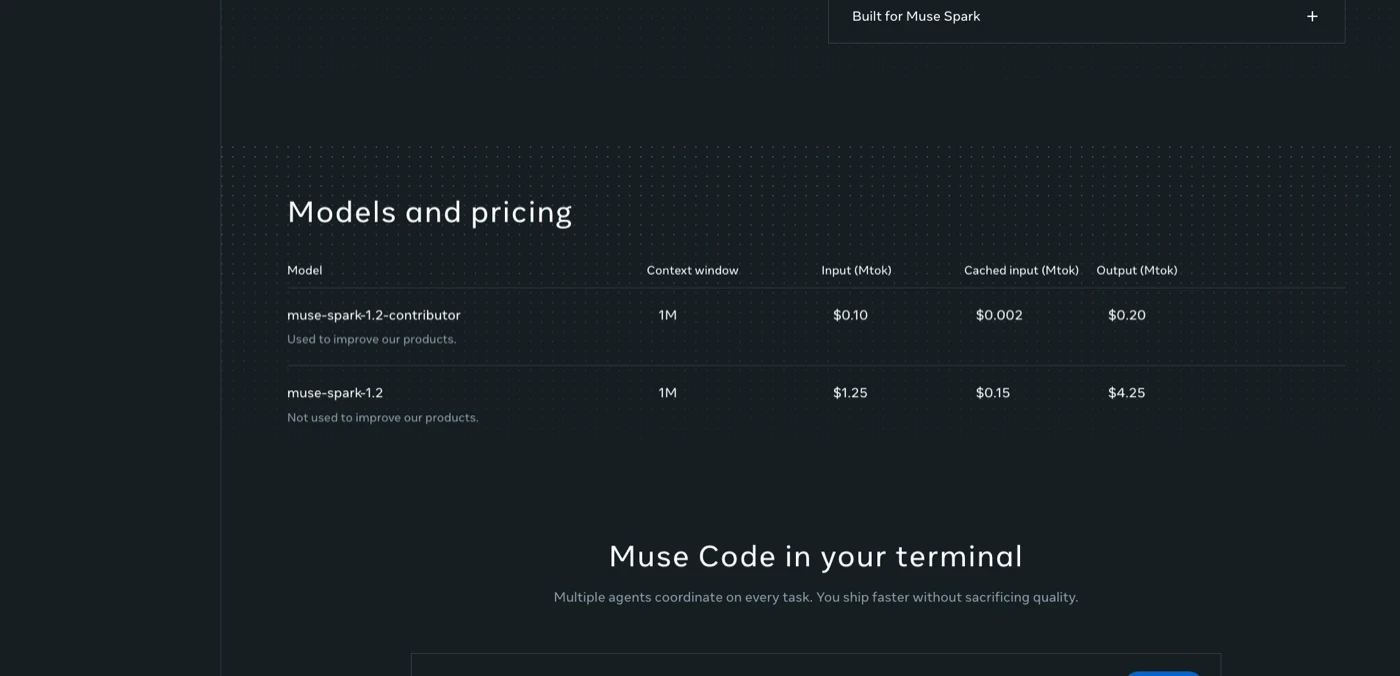
The current Muse Code developer page lists two separate model rows with different data-use labels. muse-spark-1.2-contributor carries the “used to improve Meta products” label, while muse-spark-1.2 carries the “not used to improve Meta products” label. In this table, “contributor” is a model-row name tied to the first product-improvement statement; it does not mean that a team is contributing code. The page also shows separate input, cached-input, and output prices, but it does not say which row a Muse Code beta session selects, whether either row controls beta eligibility, or whether the labels cover local event-log data. That keeps the model/data-use question separate from the access question.
What a team can decide now
The evidence supports a narrow decision. A team whose work spans planning, edits, and validation across many files can judge whether Muse Code's announced workflow is relevant to investigate. The install path still needs its own check: the captured official installer declares a ~/.local/bin/muse target, downloads a second-stage launcher, and may add PATH entries; it was syntax-checked but not executed. The public record therefore separates an announced beta, a listed install path, and an inspectable installer from a verified runtime. Access, the beta's model selection, repository access, and task completion remain separate unknowns.
The next check is bounded: reread the current developer page and inspect the current installer/access path, noting the model surface and data-use label presented and the installer's declared local changes. Stop before login, API-key creation, region or payment steps, CAPTCHA, private-repository access, or a repository task.
Discussion
0 replies