
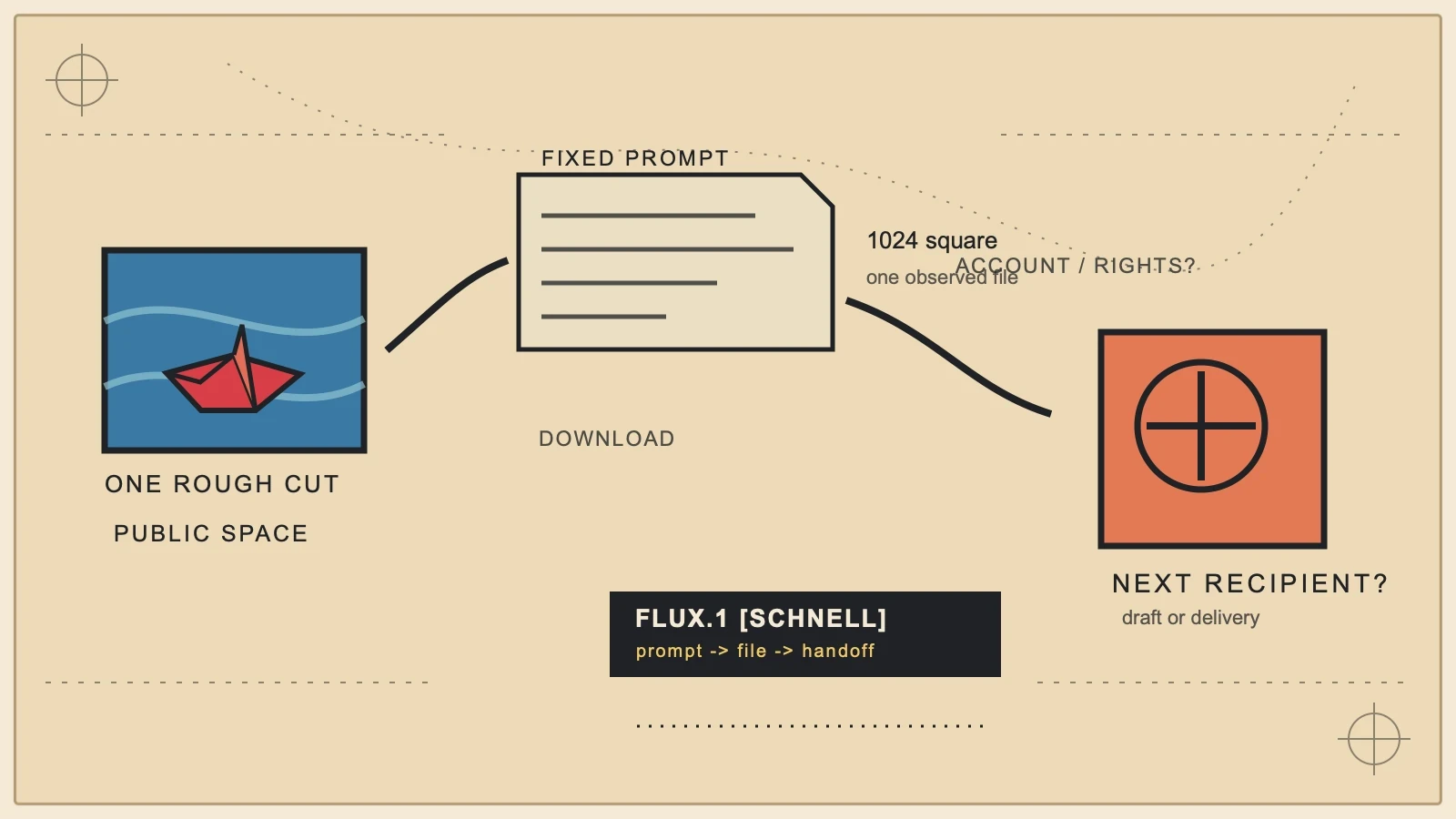
A marketer needs one square image for a draft deck, but does not want to create an account before knowing whether the idea will survive the first render. A public Hugging Face page can answer that narrow question: enter a short description, start the run, inspect the returned picture, and see whether a file can leave the page. The fixed prompt used here was A red paper boat on a blue table, soft daylight, simple editorial photograph. It returned one 1024x1024 WebP and a visible download control without asking for an account or payment. That is enough for a quick concept check. It is not enough to promise repeatable quality, later availability, or commercial clearance.
![The real English FLUX.1 [schnell] Space result screen showing the fixed prompt, a red paper boat image, progress details, and the image.webp download control.](/tool-editorial/hf-flux-schnell-anonymous-review-20260808/flux-schnell-anonymous-result.webp)
The file is the first answer, not the final promise
The returned picture is a red paper boat on a blue surface under soft daylight. It arrives as a square WebP, with the result screen exposing fullscreen, download, and share controls. That changes the question from "can the page make something?" to "is there a file worth showing to someone else?" For a creator, marketer, or researcher checking a visual direction, the answer is yes for this one rough cut.
The useful handoff is deliberately small. The file can be inspected, placed in an internal draft, or used to decide whether the prompt deserves another pass. The observed path did not establish that a second prompt would return the same format, that a later visitor would get the same access, or that the picture could be used commercially. The file is a first delivery object, not a finished delivery promise.
The rough cut arrives through a very small workflow
A Space is simply a public browser page where a prompt can be entered and an image can be returned. In the public FLUX.1 schnell demo, the workflow was: paste the fixed English prompt, click Run, watch the status line, inspect the result, and use the image.webp download link. No account, payment, API key, upload, or private input was part of this route.
The interface showed 1/4 steps | 1.7/8.1s and 25.0% while the image was being made. A queue is simply the waiting-and-processing line behind a request. No named place in that line appeared here. The step counter proved that work was moving through this request; it did not prove a guaranteed wait time, queue fairness, or a repeatable latency.
That distinction matters when the task has a clock attached. An opportunistic draft can tolerate a page that returns a file when it is available. A scheduled presentation, campaign slot, or client review needs a separately checked timing path. The visible progress state is useful feedback, but it is not a delivery schedule.
Running now does not mean ready later
At retrieval, the Hugging Face Space page showed Running on Zero. In plain language, the label says that the shared runtime behind the public page was running at that moment. It does not say that the page will remain ready after an idle period or be available at a later deadline.
The run did not wait for an idle sleep, observe a cold start, or measure a later queue. Rate limits and future uptime were not established either. The result therefore supports an available-now observation: the page was live enough to accept this prompt and return this file. It does not support an always-ready service assumption.
For a small creative decision, that may be the right trade. A person can try a concept while the page is running, keep the downloaded rough cut, and move on if the image is useful. A workflow that must start at a fixed time needs a path with documented availability or a fallback that has been checked separately.
The second door is the model repository
The public demo and the files behind the model are different access questions. On the model card, License: apache-2.0 is visible, while access to repository files requires agreement to share contact information and a login or signup. The anonymous page returned an image; the model-file page presented account and access conditions.
That is a useful boundary for anyone deciding what to do next. A visitor can use the public result to inspect an idea without treating the model repository as already available. The license label describes the model-file entry, not a ruling on the rights to the downloaded image. Output rights, hosted-service terms, and commercial use remain separate questions that this single browser path did not answer.
Black Forest Labs' original announcement positions FLUX.1 [schnell] as its fastest model for local development and personal use. The model card describes 1-4 step text-to-image generation. That context explains why a quick draft path is plausible; it does not turn one hosted result into a benchmark or a general quality claim.
The recipient decides whether the file is enough
The public path fits a narrow job: getting a disposable visual direction into a draft before adding account setup or a larger workflow. The red paper boat file is concrete enough for an internal review, a mood-board pass, or a decision about whether to rewrite the prompt. The download control matters because the result can leave the page and become something another person can inspect.
The breakpoint comes when the recipient expects more than a rough cut. A scheduled campaign needs a checked availability path. A client handoff needs the applicable output terms and a repeatability check. A local or commercial workflow needs its own access and rights review. None of those requirements can be inferred from the image.webp file or the Apache label alone.
The practical verdict is therefore modest but useful: use the public Space when the immediate job is to obtain and inspect one quick image draft, and keep the downloaded file as the rough-cut object. Stop before promising a deadline, a consistent result, permanent anonymous access, or commercial use. The next recipient, not the polished interface, decides whether this file is ready to travel.
Discussion
0 replies