
The popular version of the ChatGPT-versus-Gemini debate asks which assistant is “better.” That is the wrong question for an editor with a real article to finish. The useful question is what happens when both tools receive the same awkward, consequential brief: prepare a source-backed comparison of Canva and Adobe Express, keep the evidence visible, and hand a writer something that can survive fact checking.
That job is narrower than “ask an AI to write.” It has four joins where a polished answer can quietly fail: finding the right sources, showing which source supports which claim, turning a pile of material into a defensible angle, and handing the result to a writer without smuggling in guesses. A matched prompt was run through both assistants, then the outputs were read as editorial work products rather than as chatbot performances. Official help documentation was used to separate advertised workflow from what the surfaces actually exposed.
The result is not a universal winner. Gemini behaves like the larger research desk; ChatGPT behaves more like the editor sitting beside the writer. That distinction is more actionable than a single score.
The brief that makes the difference visible
Both assistants received the same assignment: compare them as research partners for a Canva versus Adobe Express article, using four criteria—source discovery, citation visibility, synthesis, and writer handoff. The brief asked for observations, cautions, and a recommendation, and explicitly ruled out invented sources.
The brief matters because it prevents a familiar comparison failure: one tool gets praised for features while the other gets judged on a finished paragraph. It also keeps the target task visible. The article is not rating image generation, coding, voice, or every menu in either product. It is testing the research chain that comes before publication.
There was also a useful asymmetry in the run itself. ChatGPT settled into a complete memo from the long brief. Gemini’s long comparison request stayed in an analysis state, while a shorter follow-up about source verification produced a clear, finished answer. That is not a reason to declare Gemini incapable; it is a production observation about prompt size and handoff reliability. The comparison therefore treats Gemini’s completed source-verification answer as evidence of its research-desk behavior, and keeps the unfinished long request as a boundary rather than turning it into a quality claim.
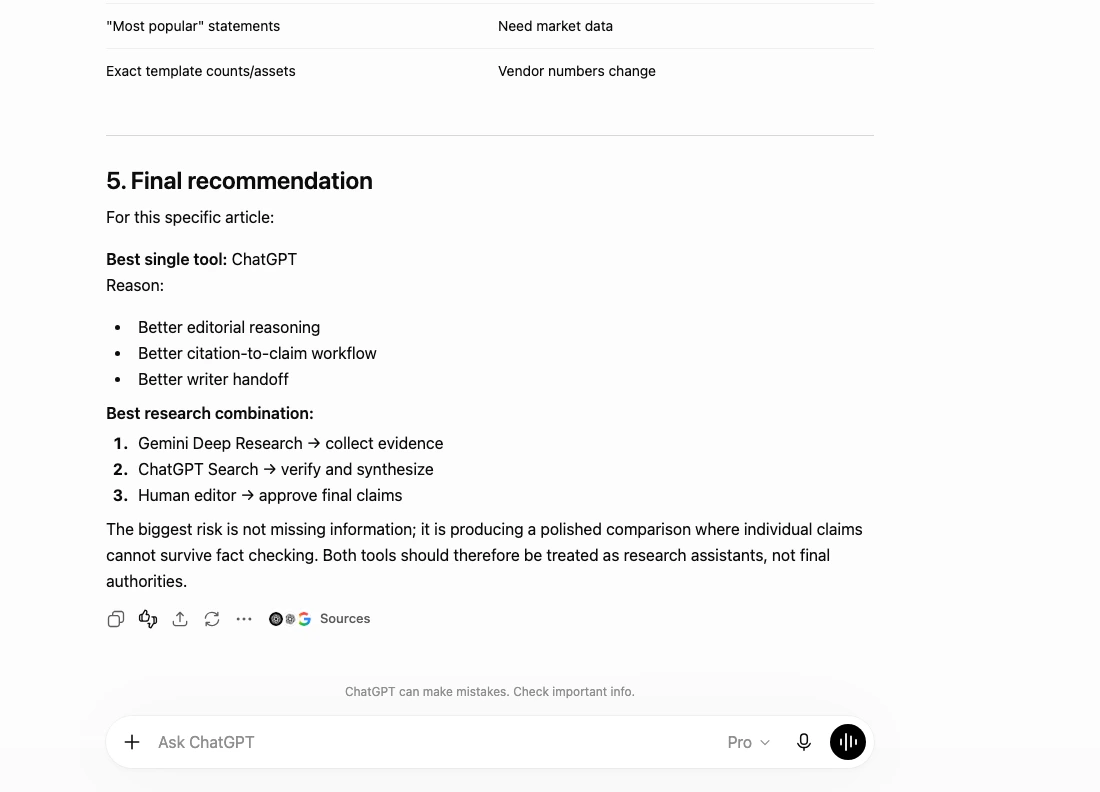
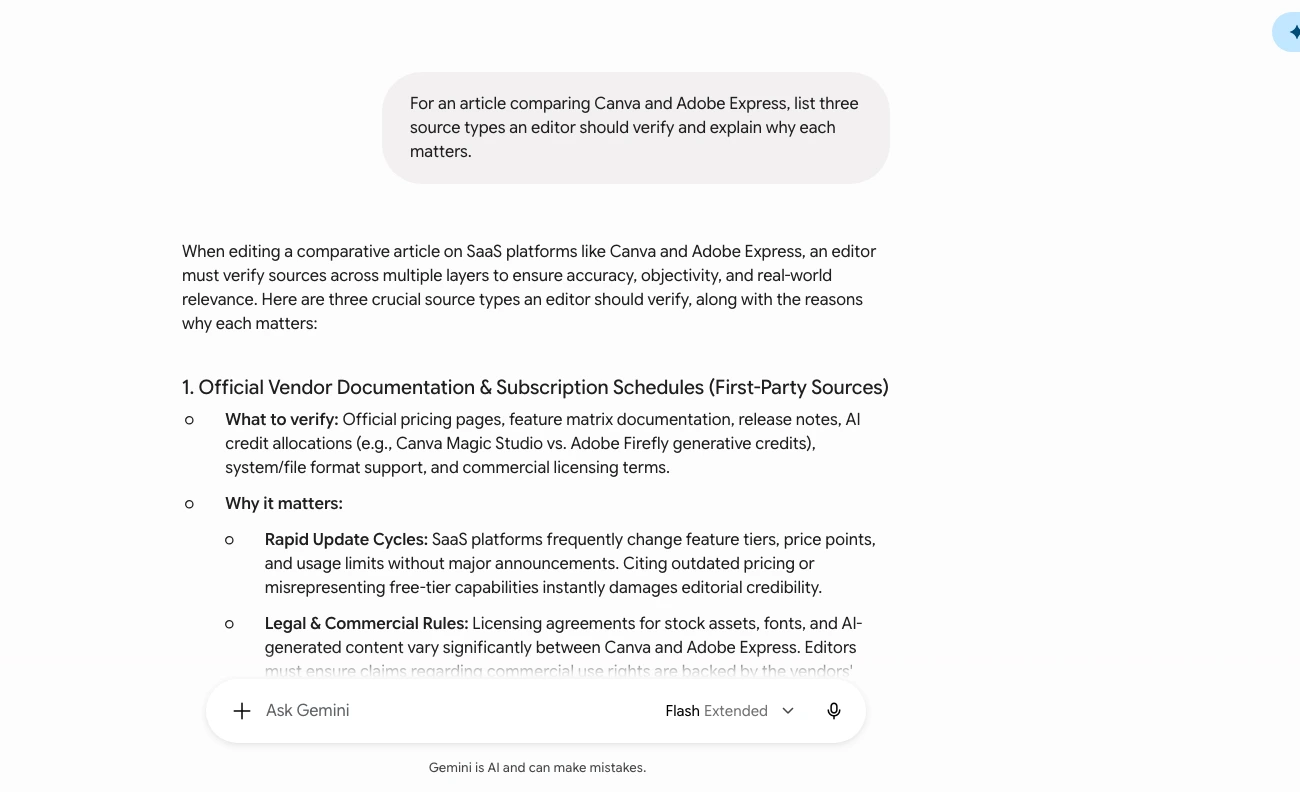
The screenshots show the central difference. ChatGPT completed the brief as a memo with a workflow and a decision. Gemini’s strongest visible contribution was the source taxonomy: official documentation and subscription terms, hands-on empirical checks, and aggregated user or professional feedback. Neither screen is a finished article. Both are useful pieces of an editorial system.
Discovery: Gemini searches wider, ChatGPT narrows faster
Gemini’s Deep Research workflow is designed for breadth. Google’s documentation says it can conduct in-depth, real-time research, include Google Search by default, add other sources, and assemble a report. That product shape fits the first pass of the Canva–Adobe Express assignment: collect pricing pages, feature documentation, AI announcements, licensing terms, independent tests, and user feedback before deciding which differences deserve space.
The advantage is not simply “more links.” It is the ability to start with a broad question and let the research surface propose a source map. In the matched work, Gemini’s source-verification response naturally separated first-party documentation, empirical testing, and third-party feedback. That categorization is a good editorial guardrail because each layer answers a different question: what the vendor promises, what the workflow actually does, and where recurring friction appears for users.
ChatGPT’s Search surface is less of a research dossier and more of a fast narrowing tool. OpenAI documents that it can search the web automatically or on request and return links to relevant sources. In the memo, the output quickly turned the broad comparison into concrete search jobs—official pricing, AI feature documentation, independent reviews, and user feedback—then moved toward what each source category would mean for the eventual story.
That makes ChatGPT particularly good after the first ten minutes of discovery. It can take a messy question such as “Which is better for Canva?” and turn it into “Which claims about templates, AI credits, export, collaboration, and Creative Cloud integration can be verified, and which are merely positioning?” Gemini is better at building the reading pile; ChatGPT is quicker at deciding what the pile is for.
| Discovery need | ChatGPT | Gemini |
|---|---|---|
| Start with an unfamiliar market | Fast orientation and query refinement | Broad research plan and source collection |
| Build source categories | Can do it with explicit prompting | Naturally frames first-party, testing, and independent layers |
| Narrow to a publishable question | Strong | Possible, but the wider report can keep expanding |
| Main risk | Stopping after a fluent first answer | Mistaking breadth for evidence quality |
The practical decision is sequential, not tribal: use Gemini when the uncertainty is “What should be in the source set?” Use ChatGPT when the uncertainty becomes “Which of these claims can carry the article?”
Citation visibility: the link is not the proof
This is the most important distinction for editors. ChatGPT’s Search documentation describes inline citations that can be opened from the response, with a Sources panel available when citations are not shown inline. That is a useful claim-level interaction: a writer can move from a sentence to the linked page without first decoding a bibliography.
The matched memo used that affordance to keep a warning list beside the recommendation. Current pricing, feature availability, “better” claims, user satisfaction, and template counts were all marked as items requiring human verification. That is a better handoff than a confident verdict because it tells the editor where the answer is still soft.
Gemini’s Deep Research reports are closer to a research packet. Google says Search is included by default and that other sources can be added. The source-verification response also made a useful distinction between source types and why each matters. That makes it easier to assemble a balanced evidence set, especially when the question spans vendor terms, practical workflow tests, and user sentiment.
The cost is that a larger source set can create an illusion of completeness. Three official pages, five reviews, and a long report do not automatically prove the sentence “Canva is better for teams” or “Adobe Express is better for professional handoff.” The exact passage, scope, plan, and test condition still need checking.
Evidence rule: a citation is a route to the evidence. It becomes evidence only after the exact passage supports the exact sentence under the same conditions.
For a final article, ChatGPT has the cleaner sentence-to-source handoff. Gemini has the stronger source-basket behavior. The difference is workflow design, not a guarantee of factual superiority.
Synthesis: one writes the angle, the other preserves the dossier
The two assistants also disagree about what “a good answer” looks like. ChatGPT’s memo was shaped for an editor: four criteria, a provisional winner per criterion, a hybrid workflow, and a final list of claims requiring verification. Its strongest move was not a clever sentence; it was converting research into an editorial decision without pretending the decision was final.
Gemini’s visible answer was more methodical. It explained what to verify in official subscription schedules, why direct empirical testing matters, and how aggregated feedback reveals patterned friction. That is exactly the material a research lead would want before assigning the tests. It protects the dossier from becoming a vendor summary, but it leaves more of the narrative angle to the human writer.
This is why a side-by-side “quality” score is misleading. ChatGPT is more useful when the problem is structure: what should the reader learn, which trade-off should lead, and what should the writer not claim? Gemini is more useful when the problem is coverage: which source families, plan terms, and user perspectives must be represented before the argument begins?
The Canva–Adobe Express brief exposes the difference cleanly. A useful comparison cannot stop at template counts or AI labels. It needs to connect a concrete job—say, turning one campaign brief into a social set and a presentation—to the actual handoff: editable files, brand controls, licensing, collaboration, and revision. Gemini helps assemble the material. ChatGPT helps turn those materials into a reader decision.
Writer handoff: the last mile decides the winner
The final handoff is where ChatGPT earns its advantage. Its memo ended with a division of labor: Gemini for broad evidence collection, ChatGPT for claim validation, angle development, and article structure, followed by a human approval pass. That is not an “AI replaces the writer” conclusion. It is a production plan a writer can actually use.
Gemini’s handoff is better understood as a research packet. Its source layers, verification reasons, and caveats make a strong briefing document, particularly for a team that wants to preserve the trail before writing begins. The packet still needs an editor to choose the opening scene, decide which differences matter to the reader, and cut attractive but irrelevant feature inventory.
| If the next task is… | Better fit | Why |
|---|---|---|
| Discover the full source landscape | Gemini | The research surface is built for broad, multi-source collection |
| Check a sentence before publication | ChatGPT | Search citations and the Sources panel make the next click obvious |
| Build a comparison angle | ChatGPT | It translates evidence into reader questions and a decision structure |
| Preserve a research dossier | Gemini | Source categories and report-style organization keep coverage visible |
| Produce a writer-ready brief | ChatGPT | The output joins evidence, angle, cautions, and next steps |
The most reliable workflow is therefore a relay:
- Ask Gemini for a source map with explicit categories and source-quality requirements.
- Ask ChatGPT to turn that map into claim-sized questions and a comparison outline.
- Open the sources, run the same Canva and Adobe Express tasks, and record the actual outputs.
- Ask ChatGPT to challenge the claims against the evidence, not to decorate the conclusion.
- Let a human editor approve the final wording, pricing, plan access, and licensing statements.
That relay also creates a useful failure signal. If Gemini returns many sources but cannot identify which passage supports a buying claim, the gap is source alignment. If ChatGPT produces a sharp recommendation without enough primary material, the gap is coverage. The workflow tells the editor what to fix instead of hiding the weakness behind a single score.
Verdict: choose the job, or use both
For a source-backed Canva versus Adobe Express article, ChatGPT is the better single handoff tool. It is faster at turning a broad research question into an editorial brief, keeping the reader decision in view, and listing claims that must not pass without checking.
Gemini is the better discovery partner when the risk is missing an important source family or failing to represent the vendor, workflow, and user perspectives. Its Deep Research model is designed for that wider sweep.
The honest recommendation is not to pick a permanent champion. Start with Gemini when the source universe is unknown; switch to ChatGPT when the evidence needs a shape; then verify both against the original pages and the real Canva–Adobe Express workflow. The assistant that saves the most time is the one whose output makes the next verification step clearer.
That is the decision a comparison reader can use—and the standard an AI comparison should meet before it earns a place in a published workflow.
Discussion
0 replies