
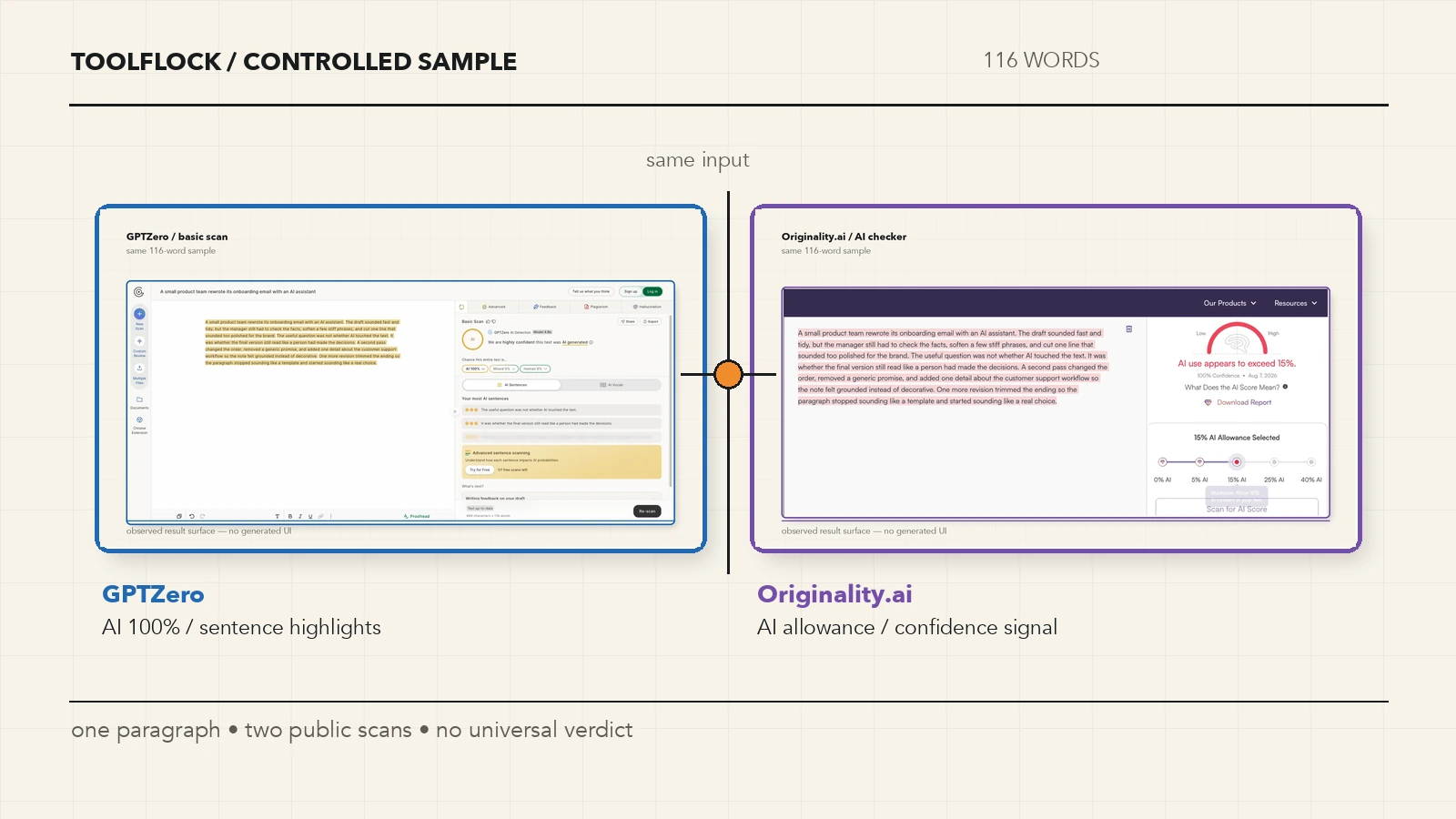
AI detectors are often presented as if they answer one clean question: was this text written by a person or a machine? A real scan is messier. The same paragraph can produce a percentage, highlighted sentences, a confidence label, or a result that changes when the public free allowance changes.
That difference matters to anyone checking an article, a student submission, a client draft, or an internal memo. The useful comparison is not a universal accuracy ranking. It is what a reader can actually see, record, and responsibly conclude from the same text.
One paragraph went into both public checkers
The shared sample was kept at 116 words and pasted unchanged into GPTZero and Originality.ai:
A small product team rewrote its onboarding email with an AI assistant. The draft sounded fast and tidy, but the manager still had to check the facts, soften a few stiff phrases, and cut one line that sounded too polished for the brand. The useful question was not whether AI touched the text. It was whether the final version still read like a person had made the decisions. A second pass changed the order, removed a generic promise, and added one detail about the customer support workflow so the note felt grounded instead of decorative. One more revision trimmed the ending so the paragraph stopped sounding like a template and started sounding like a real choice.
The comparison used the public scan path and kept the input constant. No claim is made about the paragraph’s true authorship. The point is to observe what each product does with the same input.
| Tool | Visible result | What can be read from it |
|---|---|---|
| GPTZero | AI 100%, Mixed 0%, Human 0% | A whole-text percentage plus highlighted sentences that drove the result |
| Originality.ai | “AI use appears to exceed 15%” with 100% confidence on the captured result | A threshold-based signal with a visible AI allowance control |
GPTZero gave the clearest sentence-level explanation
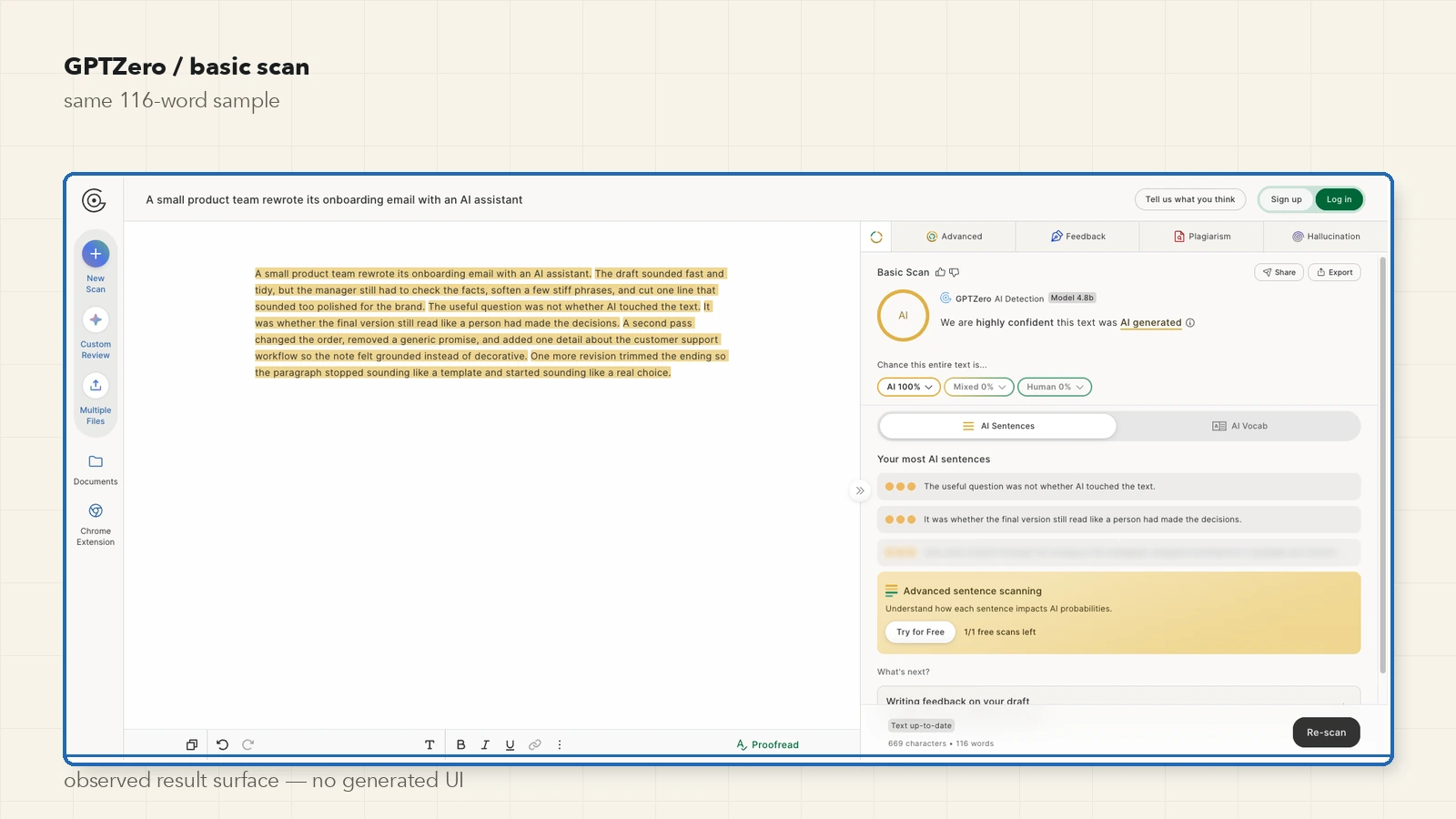
GPTZero returned a simple headline result: AI 100%, Mixed 0%, and Human 0%. The result was not limited to one percentage. The panel also highlighted sentences such as “The useful question was not whether AI touched the text” and “It was whether the final version still read like a person had made the decisions.” Those lines were marked as high AI impact in the sentence view.
That makes GPTZero useful for triage. A reviewer can move from the overall signal to the exact parts of a draft that deserve a closer look. The output still does not prove authorship, but it gives a concrete place to begin editing or asking for supporting writing history.
The public result also exposed a practical limit: the basic scan was available, while advanced sentence scanning sat behind a free-scan allowance. The free path can answer a first question; repeated checks or deeper reports may require an account or paid access.
Originality.ai answered with a threshold, not the same scale
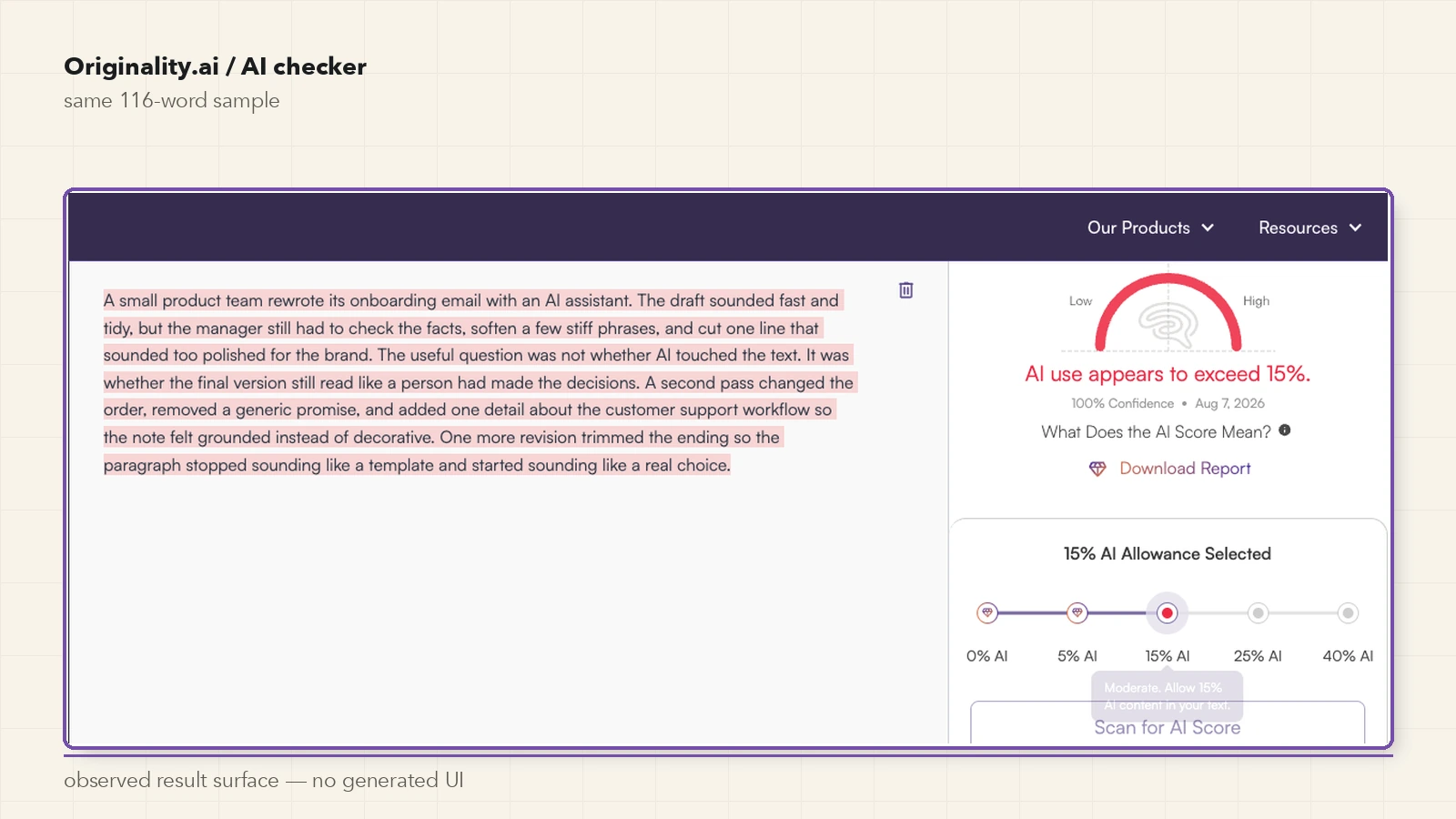
Originality.ai presented the same paragraph differently. The captured result read “AI use appears to exceed 15%” with 100% confidence, while the interface kept 15% AI allowance selected on a visible scale running from 0% to 40%.
The important detail is the control. The result is not just a fixed number; it is a decision about how much AI-assisted text the reader is willing to allow. That is a better fit for an editorial workflow where “some assistance is acceptable” and “no assistance is acceptable” are different policies.
A later revisit of the same public checker displayed “Likely AI or Original” with 52% confidence after the daily free scan allowance had been exhausted. That state is not merged into the first score or treated as a hidden correction. It is a visible reminder that a public detector result belongs to a particular scan state, model path, and allowance setting.
The outputs cannot be reduced to one leaderboard
The two products did not return competing versions of one shared number:
- GPTZero exposed a whole-text percentage and sentence-level clues.
- Originality.ai exposed a threshold judgment and a confidence readout.
- The later Originality.ai state changed the visible confidence wording on the same text.
Those are different kinds of evidence. A percentage answers “how strongly does this scan classify the text?” A highlighted sentence answers “where should a human look next?” An allowance slider answers “what level of AI assistance is acceptable for this workflow?” Treating them as if they were the same unit creates a false winner.
What the result changes in everyday work
For a quick editorial pass, GPTZero is the more immediately inspectable surface. The whole-text result and highlighted sentences make it easier to mark a draft for human review without pretending that the detector has established who wrote it.
For a policy-led workflow, Originality.ai exposes a more explicit threshold. An editor, teacher, or team can record the allowance used alongside the result, then decide whether the text needs rewriting, disclosure, or a second form of evidence.
Neither output should be used alone for a disciplinary, hiring, or authorship decision. A responsible review still needs the draft’s writing history, source notes, fact checks, or a conversation with the person who supplied it. The detector is a signal in that review, not the verdict.
The practical rule is to save the input with the result
The small test produces a useful working habit:
- Keep the exact text that was scanned.
- Record the visible result, allowance, and model or report label.
- Save the screenshot before changing the draft or running another scan.
- Treat a changed result as a new observation, not as proof that one scan was “the truth.”
The same paragraph did not reveal which detector is universally right. It revealed something more useful: GPTZero and Originality.ai expose different evidence, and even one public surface can change its confidence state. That is enough to choose a review workflow. It is not enough to assign authorship.
Discussion
0 replies